Campus Placement Drive
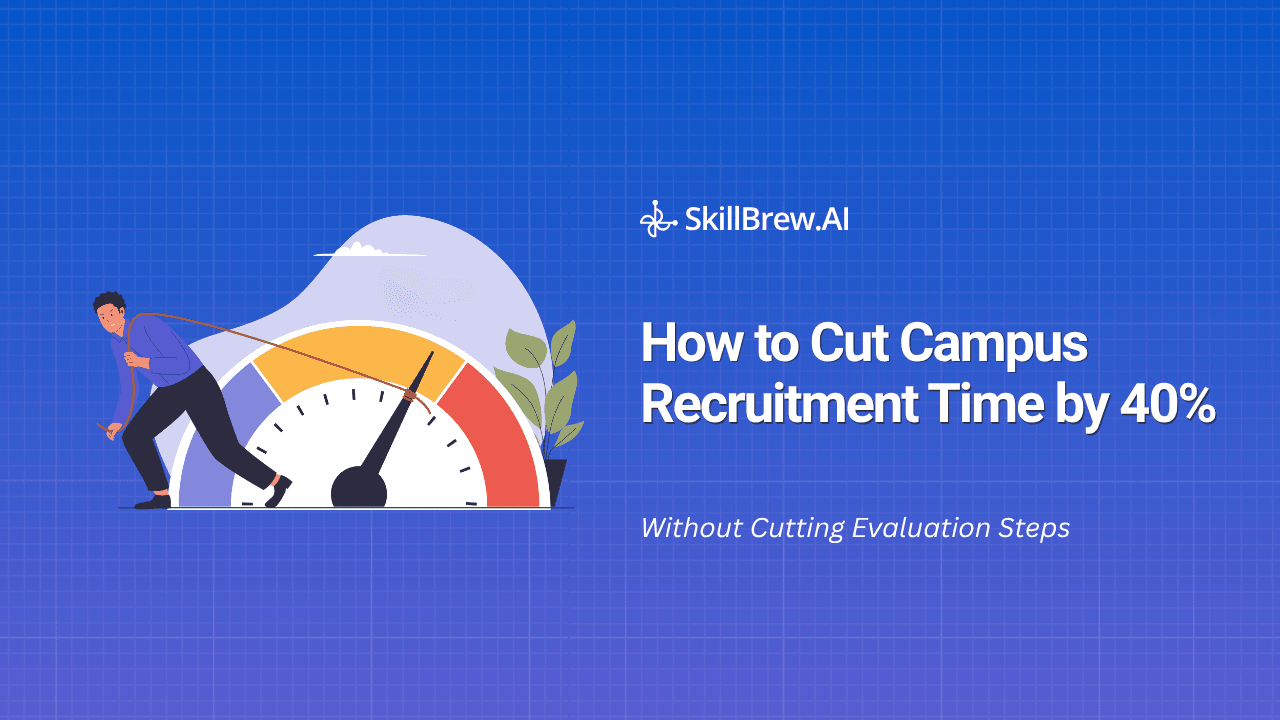
How to Cut Campus Recruitment Time by 40% Without Cutting Evaluation Steps
Consider a 21-day campus drive. In a process like this, much of the elapsed time typically comes from coordination rather than evaluation. Teams that manage to reduce time to hire aren't skipping steps or lowering their bar. They're cutting out the back-and-forth that sits between decisions. This guide walks through where a campus drive tends to lose time, stage by stage, and what it takes to reduce time to hire without dropping a single evaluation step. Quick Guide to This Article * The re
Consider a 21-day campus drive. In a process like this, much of the elapsed time typically comes from coordination rather than evaluation. Teams that manage to reduce time to hire aren't skipping steps or lowering their bar. They're cutting out the back-and-forth that sits between decisions.
This guide walks through where a campus drive tends to lose time, stage by stage, and what it takes to reduce time to hire without dropping a single evaluation step.
Quick Guide to This Article
- The real bottlenecks: why the interview round usually isn't the slow part in most efforts to reduce time to hire
- Screening at scale: cutting resume review time to reduce time to hire as volume grows
- Assessment speed: building and scoring tests faster without losing rigor
- Interview coordination: how async interviews ease the scheduling problem
- The offer window: why speed after interviews can affect candidate decisions
- Hidden delays: the untracked days between stages
- Measuring the drive: finding the actual bottleneck before fixing it
- The 40% benchmark: a stage-by-stage before-and-after example of how to reduce time to hire
- Getting started: what a faster process can look like on your own roles
The Real Campus Hiring Bottlenecks: Why Interviews Aren't the Problem
Ask most Talent Acquisition leaders what slows a campus drive down, and many will point to the interview round. In practice, it's often not the main driver. A meaningful share of the delay tends to sit in intake and coordination work, the kind of work that doesn't need human judgment but still gets handled manually. That's usually the first place to look for teams that want to reduce time to hire.
Here's an illustrative breakdown of how a 21-day campus drive's time might be spent:
- Days 1-5: Manual resume review across multiple campuses, a stretch that automated scoring can often compress significantly.
- Days 5-9: Assessment setup, delivery, and result collection, often slowed by manual question-building and individual invites.
- Days 9-15: Interview scheduling, confirmation follow-ups, no-show handling, and note collection.
- Days 15-19: Offer approval sitting in a template draft, waiting on compensation sign-off.
- Days 19-21: Offer dispatch and candidate confirmation.
The evaluation itself, the piece that genuinely needs a Talent Acquisition team's judgment, might only take four to five days of that total. The rest is largely coordination. Fixing that layer, rather than the evaluation itself, can be one of the most direct ways to reduce time to hire.
Resume Screening at Scale: Speeding Up Candidate Screening Without Cutting Corners
Manual screening across several hundred applications and multiple campuses can take dozens of hours of reviewer time. At that volume, reviewer fatigue can also become a factor, making consistency harder to maintain across a large batch.
Automated resume screening addresses this at intake. Applications are scored against the job description as they arrive, so a ranked shortlist can exist before anyone opens a file manually. For teams looking to reduce time to hire, this is often one of the higher-leverage stages to fix, since a faster shortlist has knock-on effects on everything downstream.
This is the kind of workflow SkillBrew.AI's HireFlow is built around: applications arrive, get scored against the job description, and surface as a ranked list automatically, so the team starts the drive with a shortlist rather than a spreadsheet to build one. This is one of the more direct ways teams reduce time to hire at the top of the funnel.
Cutting Bulk Assessment Turnaround Without Losing Rigor
Manually building a test takes time. Coordinating delivery takes more. Collecting and formatting results for the panel adds further delay, especially if the hiring manager adjusts requirements mid-drive.
A bulk-hiring assessment workflow can remove much of that overhead, which helps teams reduce time to hire without loosening evaluation standards. A job description can be used to generate a role-relevant assessment, whether coding, aptitude, or psychometric, in a matter of minutes, with one invite reaching the entire batch and results returning ranked on a consistent scale.
SkillBrew.AI's Technical Assessments work this way, generating role-specific questions directly from a job description so the team isn't building a question bank from scratch, with built-in integrity checks during the test itself.
Interview Scheduling: How Async Interviews Ease the Bottleneck
Coordinating dozens of first-round interviews across multiple campuses is a significant chunk of work on its own, before confirmations, no-show rescheduling, and post-interview note collection are factored in. This stage is frequently one of the biggest obstacles to any effort to reduce time to hire.
Async interviews can eliminate much of the scheduling bottleneck. Candidates complete interviews on their own time, without a slot to book or a confirmation email to chase, and a structured report can be generated after the candidate completes the interview.
SkillBrew.AI's AI Interviews use an adaptive, resume-aware avatar that asks follow-up questions based on each candidate's background rather than a fixed script, producing a report on communication quality, response depth, and role-relevant signals. Replacing several days of manual scheduling with an on-demand interview workflow can meaningfully compress this part of the cycle.
The Offer Window: Why Speed After Interviews Matters
Once the final interview wraps, there's typically a short window before candidates commit elsewhere. Placement-season candidates are often weighing more than one offer at a time, and a slower offer process can lose out to a faster one, sometimes disproportionately among the strongest candidates, who tend to have more options.
A reasonable target is to move from final interview to offer dispatch in a few days rather than more than a week. Getting there usually means pre-approving the offer template before the drive begins, locking compensation structure ahead of panel interviews, and letting the offer trigger fire automatically once a selection is confirmed. This is one of the last stages worth checking when a team wants to reduce time to hire, since a strong candidate can be lost in the final stretch even after every earlier stage runs smoothly.
The conversation around the offer should stay human. The dispatch itself can be automated once the necessary approvals are complete. Getting this backwards is a common way an otherwise efficient process quietly loses candidates late in the cycle.
Hidden Delays: The Time Lost Between Stages
The space between stages often costs more time than the stages themselves. An assessment closes, but interview invites sit unsent for a day or two because whoever owns that step is buried in other work. An interview finishes, but panel notes wait in an inbox until someone follows up.
These gaps rarely show up in a drive review because inter-stage time is rarely tracked in the first place. Left unaddressed, they can add several days across a drive, time spent entirely on waiting rather than working. Any real plan to reduce time to hire has to account for this dead time, not just the time spent actively working each stage.
Automated stage management is designed to close these gaps. An assessment closing can trigger interview invites automatically. Completed interviews can push reports to the panel without a manual send. A confirmed selection can fire the offer trigger. This kind of handoff automation, which SkillBrew.AI's HireFlow is built to manage, is often what separates a process that reduces time to hire on paper from one that does it in practice.
Measuring Campus Recruitment Cycle Time Before Trying to Fix It
Any serious attempt to reduce time to hire starts with knowing the current baseline. Many Talent Acquisition teams don't track cycle time stage by stage, which makes it difficult to pinpoint where time is really going. Knowing a drive took three weeks isn't the same as knowing which week caused the delay.
Track total days from application open to offer dispatch, then break that down: screening days, assessment days, interview coordination days, offer approval days. In many drives, coordination accounts for a larger share of total time than evaluation does, though the exact split will vary by team and process.
Once the bottleneck is identified, the fix gets specific. A screening bottleneck calls for automated shortlisting. An interview bottleneck calls for async interviews. An approval bottleneck calls for a pre-cleared template and a shorter sign-off chain. Fixing the wrong stage wastes the next drive's worth of effort to reduce time to hire and leaves the downstream delays untouched.
What a 40% Faster Turnaround Can Look Like, Stage by Stage
A manual campus drive can run several weeks from application open to offer dispatch. Here's an illustrative comparison of what the same drive might look like with automated shortlisting, AI-assisted assessments, async interviews, and automated offer triggers, the combination most teams use to reduce time to hire:
| Stage | Manual Process | Optimized Process |
| Screening | 5 days | 2 days |
| Assessment | 5 days | 3 days |
| First-round interview | 6 days | 4 days |
| Offer approval | 4 days | 3 days |
| Total active process time | 20 days | 12 days |
How the 40% figure is calculated: (20 − 12) ÷ 20 × 100 = 40%
This is an illustrative model, not a guaranteed outcome. Actual savings will depend on application volume, assessment complexity, interviewer availability, approval workflows, and the level of automation already in place.
No evaluation step disappears, and no decision is made with less information. What changes is the time spent coordinating between decisions, the core idea behind any effort to reduce time to hire.
If Coordination Is the Bottleneck, a System Is the Fix
When a campus drive stretches into weeks and strong candidates start accepting offers elsewhere, coordination delays can become an important part of the problem. In many cases, the bigger opportunity is reducing the coordination wrapped around evaluation rather than removing evaluation itself, and closing that gap tends to be one of the most direct ways to reduce hiring delays this placement season.
SkillBrew.AI is built around the stages where time most often leaks out: automated resume shortlisting through HireFlow, role-linked assessments delivered to a full batch without manual setup, and async AI interviews that screen every shortlisted candidate without a scheduled slot. A walkthrough on actual roles and job descriptions is a practical way to see where a specific drive's time is going.
See AI-powered hiring in action
Discover how SkillBrew helps hiring teams cut time-to-hire by 60% with skill-validated assessments and AI-ranked shortlists.
Book a free demoNo commitment required · 30 minutes
Continue reading
View All Posts