BrewVoice
How to Measure the ROI of AI Voice Screening in Recruitment
Consider a recruitment team where a recruiter spends 12 minutes screening each candidate. At 10,000 screens a year, that translates to roughly 2,000 hours of recruiter time every year, time that could otherwise go toward interviews, candidate engagement, and closing hires. That is exactly why AI voice screening ROI deserves a proper business case instead of a gut feeling. Recruitment teams are under constant pressure to hire faster while managing growing candidate volumes. First-round screening

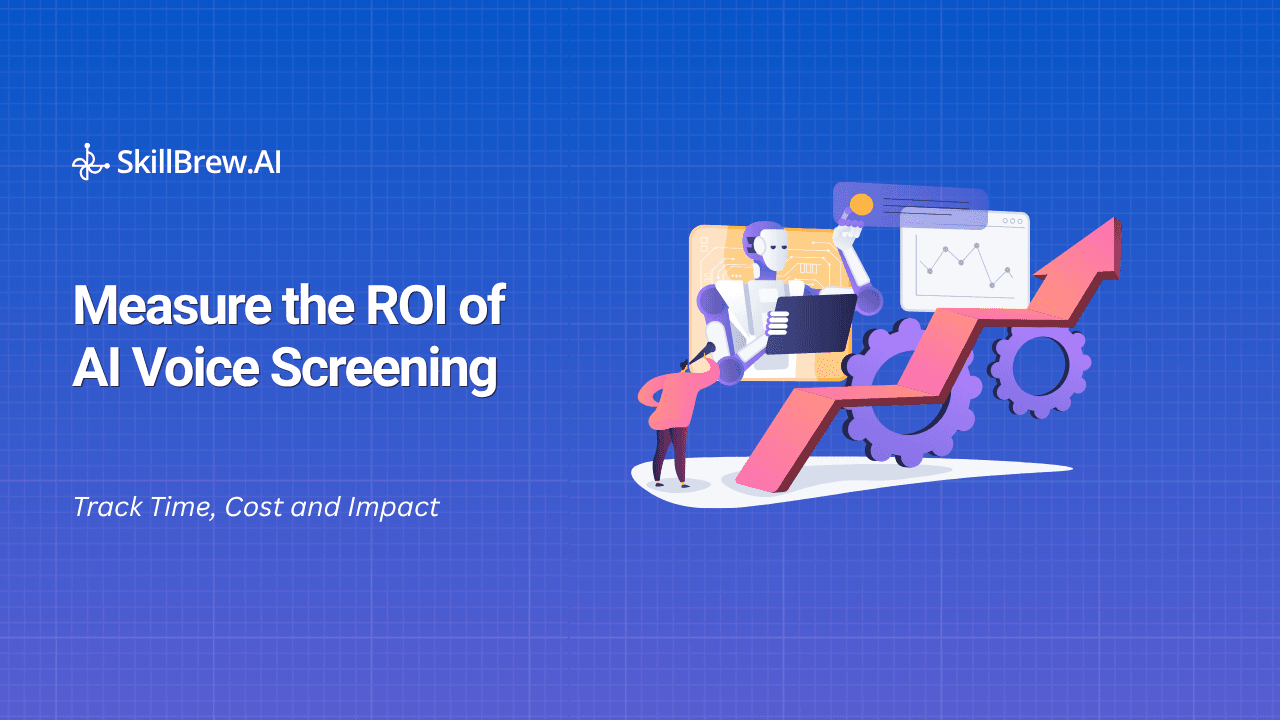
Consider a recruitment team where a recruiter spends 12 minutes screening each candidate. At 10,000 screens a year, that translates to roughly 2,000 hours of recruiter time every year, time that could otherwise go toward interviews, candidate engagement, and closing hires. That is exactly why AI voice screening ROI deserves a proper business case instead of a gut feeling.
Recruitment teams are under constant pressure to hire faster while managing growing candidate volumes. First-round screening calls are usually where that pressure shows up first: the same qualification questions, repeated hundreds of times, followed by note-taking, ATS updates, and chasing candidates who never picked up.
AI voice screening handles structured first-round conversations, checks responses against predefined criteria, and hands recruiters a structured result instead of a stack of call notes. But the business case for it shouldn't rest on how many calls a system can make. It should rest on whether the technology saves recruiter time, lowers cost per screen, speeds up shortlisting, and lets the team handle more requisitions without adding headcount.
This guide walks through how to calculate AI voice screening ROI, which metrics to track after implementation, and how to build a business case that a finance team would actually sign off on.
Table of Contents
- What Is AI Voice Screening ROI?: What counts as "value" in an automated screening business case.
- Why Measure AI Voice Screening ROI?: The difference between automating calls and improving outcomes.
- What Value Does AI Voice Screening Create?: Direct financial, operational, and hiring value, organized into one framework.
- How to Calculate AI Voice Screening ROI: Manual cost, automated cost, net savings, ROI, and payback period.
- A Worked Example: A realistic screening scenario, plus a reusable ROI calculator.
- Which Metrics Should You Track?: The KPI dashboard to run after go-live.
- Beyond Cost Savings: Time-to-hire, recruiter productivity, response rate, and shortlist quality.
- Common ROI Calculation Mistakes: The assumptions that quietly break a business case.
- How BrewVoice Supports Measurable Screening ROI: Where SkillBrew.AI's voice agent fits into this framework.
- FAQ: Quick answers to the questions finance and TA leadership ask most often.
What Is AI Voice Screening ROI?
AI voice screening ROI measures the financial and operational return a recruitment team gets from automating voice-based candidate screening. The basic formula:
ROI = (Total Benefits − Total Investment) ÷ Total Investment × 100
Where total benefits are the measurable savings automation generates, and total investment covers platform fees, telephony, implementation, human review time, and any other relevant costs. For recruitment teams, "benefits" is broader than a software line item. It typically includes:
- Reduced recruiter hours spent on phone screening
- Lower cost per completed screen
- More candidates processed without added headcount
- Shorter time-to-shortlist
- Less candidate waiting time
- More consistent follow-up
- Structured, comparable screening data instead of scattered notes
A narrow ROI calculation that only compares a subscription fee to recruiter salaries misses most of this. AI voice screening ROI needs to be evaluated across the full screening workflow, not just the software cost.
For the worked examples in this guide, we use net screening savings as the measurable value generated. Capacity gains and hiring-quality improvements are real value too, but they're tracked separately as additional business benefits rather than folded into the cost calculation, since they're harder to reduce to a single rupee figure.
Why Measure AI Voice Screening ROI?
Buying screening technology without measuring its impact makes it impossible to know if the investment is actually working. A team can automate thousands of calls and still fail to improve hiring if the calls produce weak signal or recruiters end up re-reviewing everything anyway.
A proper AI voice screening ROI analysis answers questions like:
- How many recruiter hours are we actually saving?
- What does each completed screen cost us now versus before?
- How many more candidates can the team evaluate in the same time?
- Has time-to-shortlist improved, and by how much?
- Are recruiters spending more time with qualified candidates instead of unqualified ones?
- Has cost per hire moved?
- Are fewer candidates dropping off because of slow follow-up?
These questions are what turn AI voice screening from a technology purchase into a measurable business investment, and they're the difference between a vendor pitch and an internal business case.
What Value Does AI Voice Screening Create?
It helps to sort the value AI voice screening ROI captures into three buckets, rather than treating every benefit as the same kind of number.
Direct financial value
- Reduced screening labor cost
- Lower cost per screen
- Lower cost per qualified candidate
Operational value
- More candidates screened per week without adding recruiters
- Faster time-to-shortlist
- Higher recruiter capacity per requisition
- Faster candidate follow-up
Hiring value
- More consistent screening criteria across recruiters and requisitions
- Higher screening-to-interview conversion
- Better candidate experience, when the calls are well designed
- Higher overall quality of shortlist
Most ROI conversations stop at the first bucket. The stronger business case considers all three categories, but not every benefit needs to be converted into a rupee figure. Direct financial savings can form the core ROI calculation, while operational and hiring improvements are reported alongside it as additional business outcomes.
How to Calculate AI Voice Screening ROI
Step 1: Calculate Your Current Manual Screening Cost
Annual manual screening cost = Number of screens × Average screening time × Recruiter hourly cost
Example:
- 10,000 candidates screened annually
- 12 minutes per screening
- ₹500 fully loaded recruiter cost per hour
10,000 × 12 minutes = 120,000 minutes → 2,000 recruiter hours
2,000 × ₹500 = ₹10,00,000 annual manual screening cost
Step 2: Calculate the Automated Screening Cost
Include everything the AI workflow actually costs, not just the platform fee:
- AI platform fees
- Voice or telephony charges
- Integration costs, if applicable
- Human review time
- Implementation costs
Example: ₹3 lakh in platform and telephony costs, plus ₹2 lakh in recruiter review time = ₹5 lakh total automated screening cost
This simplified example covers recurring operating costs only. One-time implementation cost is handled separately in Step 5, so it isn't folded into this ₹5 lakh figure.
Step 3: Calculate Net Savings
Net savings = Manual screening cost − Automated screening cost
₹10 lakh − ₹5 lakh = ₹5 lakh net savings
Step 4: Calculate ROI
ROI = (Total Benefits − Total Investment) ÷ Total Investment × 100
On a recurring-cost basis, using the ₹5 lakh automated screening cost as total investment:
ROI = (₹10 lakh − ₹5 lakh) ÷ ₹5 lakh × 100 = 100% operating-cost ROI
That figure holds before one-time implementation costs. For a full first-year ROI, implementation needs to go into total investment. If implementation costs ₹1,00,000:
Total first-year investment = ₹5,00,000 + ₹1,00,000 = ₹6,00,000
First-year ROI = (₹10,00,000 − ₹6,00,000) ÷ ₹6,00,000 × 100 = 66.7%
Both numbers are correct, they just answer different questions. The 100% figure shows the ongoing economics once the system is running; the 66.7% figure shows what a finance team actually sees in year one. Lead with first-year ROI in any business case, and use the operating-cost figure to show how the number improves in year two once implementation is already paid for. Keep net savings, ROI, and cost savings as distinct terms in any business case; using them interchangeably is where most internal ROI decks lose credibility with finance.
Step 5: Calculate Payback Period
Finance and TA leadership will usually ask a more direct question before they ask about ROI percentage: how quickly does this pay for itself?
Payback period = Upfront implementation cost ÷ Monthly net savings after recurring screening costs
If implementation costs ₹1,00,000 and the workflow generates ₹50,000 in net savings per month after recurring AI costs:
₹1,00,000 ÷ ₹50,000 = 2 months
The ₹1,00,000 here is a one-time cost, kept separate from the recurring operating cost already factored into the ₹50,000 monthly net savings figure, so it isn't being counted twice.
A short payback period is often more persuasive to decision-makers than a high ROI percentage on its own, because it answers the "when do we see this working" question directly.
A Worked Example
Consider a company hiring for high-volume customer support roles. It receives 5,000 applications a quarter and manually screens 1,500 candidates.
Each phone screen takes about 10 minutes, including documentation: 1,500 × 10 minutes = 15,000 minutes, or 250 recruiter hours per quarter.
At a fully loaded recruiter cost of ₹400 per hour: 250 × ₹400 = ₹1,00,000 manual screening cost per quarter.
With AI voice screening in place, the AI conducts initial conversations and produces structured results; recruiters review shortlisted candidates instead of running every first call themselves. Combined AI, telephony, and review cost: ₹45,000 per quarter.
Quarterly net savings: ₹1,00,000 − ₹45,000 = ₹55,000, or ₹2,20,000 annualized.
AI Voice Screening ROI Calculator
Once the methodology is clear, this is the reusable version: swap in your own screening volume, average handling time, and recruiter cost to build a business case on your numbers instead of a generic industry claim.
| Input | Example |
| Candidates screened/year | 10,000 |
| Average screening time | 12 minutes |
| Recruiter hourly cost | ₹500 |
| Annual manual screening cost | ₹10,00,000 |
| AI + telephony cost | ₹3,00,000 |
| Human review cost | ₹2,00,000 |
| One-time implementation | ₹1,00,000 |
| Total first-year investment | ₹6,00,000 |
| First-year net savings | ₹4,00,000 |
| First-year ROI | 66.7% |
Beyond Cost Savings
A strong AI voice screening ROI case doesn't stop at recruiter hours.
Time-to-hire. Track average time from application → screening → shortlist, before and after implementation.
Recruiter productivity.
| Metric | Before AI | After AI |
| Candidates screened/recruiter | 100 | 250 |
| Screening hours/week | 20 | 8 |
| Requisitions managed | 5 | 8 |
| Time-to-shortlist | 3 days | 1 day |
The exact numbers will vary by organization, but the principle holds: measure whether recruiters are freed up for work that actually needs human judgment.
Candidate response rate. Track calls attempted, calls connected, completed screenings, drop-offs, and time to first contact. Voice automation can potentially improve candidate experience when the calls are convenient, conversational, transparent about being AI-driven, and easy to complete. It can just as easily make experience worse with a clunky, robotic script, so this is a design outcome to verify, not an automatic benefit to assume.
Quality of shortlists. Track screening-to-interview conversion, interview-to-offer conversion, offer-to-joining conversion, and hiring-manager acceptance rate. Speed that lowers shortlist quality isn't a win, and any complete AI voice screening ROI picture has to account for this.
Which Metrics Should You Track?
Build a baseline before launch and compare against it after implementation.
| KPI | What to Measure |
| Screening volume | Candidates screened per week/month |
| Screening cost | Cost per completed screen |
| Recruiter hours | Hours spent on initial screening |
| Time-to-shortlist | Application-to-shortlist duration |
| Call completion rate | Percentage of candidates completing calls |
| Qualification rate | Candidates meeting screening criteria |
| Interview conversion | Screened candidates progressing to interviews |
| Cost per qualified candidate | Total screening cost ÷ qualified candidates |
| Recruiter capacity | Candidates/requisitions managed per recruiter |
| Candidate drop-off | Candidates lost during screening |
Tracking these on a rolling basis is what makes AI voice screening ROI a live number your team manages, instead of a one-time slide in a vendor pitch.
Common ROI Calculation Mistakes
Looking only at software cost. Comparing a subscription fee to recruiter salaries produces an incomplete number. Include the full workflow cost: platform, telephony, integration, and human review time.
Ignoring recruiter capacity. If automation lets a recruiter manage twice the requisitions, that has real economic value even without a headcount reduction.
Measuring volume instead of outcomes. Screening 10,000 candidates isn't automatically valuable. Measure how many qualified candidates advanced and whether hiring outcomes actually improved.
Using unrealistic savings estimates. Industry benchmarks are a starting point, not a substitute. Your AI voice screening ROI should be built from your own hiring volume, recruiter cost, screening duration, and platform pricing, since these vary widely between organizations.
Ignoring quality and fairness. Automation should support better hiring decisions, not just faster ones. AI hiring systems have drawn scrutiny around transparency and the risk of reproducing discriminatory patterns at scale. Building this into the ROI conversation from the start, rather than bolting it on afterward, is what keeps a screening automation program defensible.
Treat fairness as an ongoing operating discipline: keep screening criteria job-relevant, use consistent questions, maintain human oversight for edge cases, and regularly review outcomes for unexpected disparities. Candidates should also be informed when they're interacting with an AI system.
How BrewVoice Supports Measurable Screening ROI
BrewVoice, SkillBrew.AI's outbound voice screening agent, is built around this ROI framework rather than around call volume alone. It runs structured first-round conversations over WhatsApp and telephonic calls in 10+ languages, handling 500+ outbound calls a day, and returns a 3-signal dashboard report covering role fit, technical signal, and communication clarity.
That structure maps directly onto the metrics that matter for AI voice screening ROI:
- Calls attempted and calls completed
- Screening completion rate
- Qualified candidates identified
- Recruiter review time per candidate
- Cost per completed screening
- Cost per qualified candidate
BrewVoice is designed for high-volume screening workflows where recruiters need structured candidate signals rather than raw call transcripts. Its workflow can be particularly relevant for frontline, blue-collar, staffing, RPO, and multilingual hiring environments. AI-driven screening workflows can reduce screening time and recruiter workload, with results varying by hiring volume, role, and process design, which is exactly why this guide's Step 1 through Step 5 calculation is built to help you verify the numbers against your own hiring volume, not take a vendor's headline figure on faith.
The goal isn't removing recruiters from the process. It's removing the repetitive first-round work so recruiters spend their time on the calls and decisions that actually need a human.
Book a BrewVoice demo to see how the workflow can fit your screening volume and recruitment process.
FAQ
Q1. How do you calculate the ROI of AI voice screening?
Subtract your total investment from your manual screening cost, then divide by the total investment and multiply by 100. For first-year ROI, total investment includes one-time implementation cost alongside the recurring platform, telephony, and human review costs; for an ongoing operating-cost view, use just the recurring costs.
Q2. What costs should be included when calculating AI voice screening ROI?
Platform fees, telephony or call-minute charges, integration costs, implementation costs, and ongoing human review time. Leaving out review time is the most common way teams overstate their savings.
Q3. Does AI voice screening reduce recruiter headcount?
Not necessarily. Many teams redeploy freed-up recruiter time toward more requisitions, faster follow-up, and interview scheduling rather than cutting headcount. That capacity gain is still ROI, just not a payroll line item.
Q4. How can recruiters measure the quality of AI voice screening? Track screening-to-interview conversion, interview-to-offer conversion, and hiring-manager acceptance rate. If these decline as volume increases, screening criteria need review before scaling further.
Q5. What is a good ROI for recruitment automation?
There is no universal benchmark for a good ROI. The right target depends on screening volume, recruiter cost, automation cost, and the value you assign to additional recruiter capacity. The payback period is usually the more decision-useful number for comparing options.
Q6. How long does it take for AI voice screening to pay for itself?
Use payback period = implementation cost ÷ monthly net savings. The actual timeline depends on screening volume, implementation cost, recruiter cost, and the price of the AI workflow. High-volume teams tend to reach payback faster, since fixed implementation costs get spread across more screenings.
Q7. Does AI voice screening introduce bias risk?
It can, like any screening process, if criteria aren't job-relevant or outcomes aren't reviewed. Structured questions, consistent criteria, and regular outcome monitoring are what keep the risk in check.
Final Takeaway
Start with your own numbers: how many candidates you screen, how much recruiter time that consumes, what that time costs, and how quickly candidates move through the process. Then compare that against the full cost of an automated voice screening workflow, not just the software fee.
Don't stop at cost savings. A complete AI voice screening ROI analysis accounts for recruiter capacity, screening coverage, time-to-shortlist, candidate experience, cost per qualified candidate, and payback period, and it holds up when finance asks where the numbers came from.
The question isn't whether AI can make recruitment calls. It's whether those calls produce measurable improvements in the economics and speed of your hiring process, numbers you can defend, not just numbers you can pitch.
See AI-powered hiring in action
Discover how SkillBrew helps hiring teams cut time-to-hire by 60% with skill-validated assessments and AI-ranked shortlists.
Book a free demoNo commitment required · 30 minutes
Continue reading
View All Posts