Technical Screening
Meet SkillBrew.AI: A Kula AI Alternative Built for Initial Screening
SkillBrew.AI is the Kula AI alternative built for verified first-round screening. Compare sourcing, screening, and pricing before you decide. Kula.AI builds the pipeline. It sources candidates, tracks them through an ATS, and automates outreach across LinkedIn, email, and SMS. What it does not do is answer the question every recruiter asks once that pipeline fills up: who in here can actually do the job? That gap is exactly why "Kula AI alternative" has become a real search query for talent te

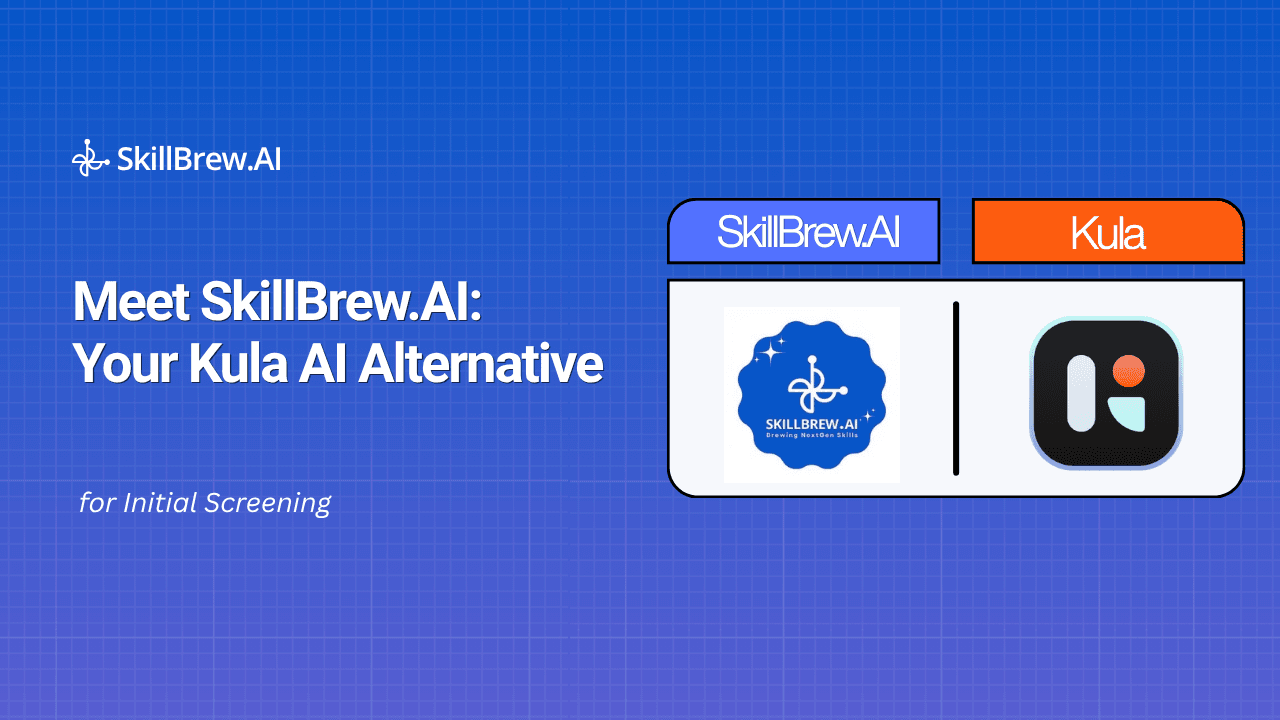
SkillBrew.AI is the Kula AI alternative built for verified first-round screening. Compare sourcing, screening, and pricing before you decide.
Kula.AI builds the pipeline. It sources candidates, tracks them through an ATS, and automates outreach across LinkedIn, email, and SMS. What it does not do is answer the question every recruiter asks once that pipeline fills up: who in here can actually do the job?
That gap is exactly why "Kula AI alternative" has become a real search query for talent teams. Not because Kula is a weak product, but because sourcing and verification are two different problems, and most fast-growing teams eventually need a tool built for each one.
This guide breaks down SkillBrew.AI and Kula honestly: what each platform actually does, where they overlap, where they diverge, and whether they belong in the same hiring stack. By the end, the goal is a clear answer to whether a Kula AI alternative even makes sense for a given hiring team.
Table of Contents
- Why Recruiters Look for a Kula AI Alternative
- What Is SkillBrew.AI?
- What Is Kula.AI?
- Kula AI Alternative: A 1-Minute Summary
- Sourcing and Pipeline Building: Which Platform Fills the Funnel?
- Initial Screening: Which Platform Verifies Candidates?
- Candidate Assessment and Proctoring
- Recruiter Workflow and Shortlisting
- Pricing: Kula.AI Pricing vs SkillBrew.AI Pricing
- How to Choose Between SkillBrew.AI and Kula.AI
- Can They Be Used Together?
- Why Teams Choose SkillBrew.AI as Their Kula AI Alternative
- Frequently Asked Questions
- Final Verdict and Recommendation Matrix
A full pipeline still needs a first-round screen. Kula.AI gets candidates into the system and keeps them moving. It does not tell a recruiter which of those candidates can actually do the job, because Kula's AI scoring works off resumes, not verified evidence.
This is exactly why so many talent acquisition teams start searching for a Kula AI alternative. Kula is a respected AI-native ATS, but sourcing and verification are two different jobs:
- Kula.AI is built to fill the pipeline. It sources candidates from LinkedIn and GitHub, automates outreach, and tracks everyone in one CRM and ATS.
- SkillBrew.AI is built to verify who is actually in that pipeline. It runs an AI voice interview, a skills assessment, and a proctored integrity check before a recruiter ever picks up the phone.
This guide compares both platforms across sourcing, screening, assessment, workflow, and pricing, so a hiring team can decide whether a Kula AI alternative belongs in their stack, and where Kula itself still earns its place.
Why Recruiters Look for a Kula AI Alternative
Most hiring teams do not struggle to find candidates. They struggle to trust what they are looking at once the candidates arrive.
- Resume scores are not proof of skill. Kula's AI Scoring stack-ranks candidates based on resume criteria, which is useful for prioritization but does not confirm whether a top-ranked resume reflects a top-performing candidate.
- Sourcing tools fill the funnel faster than recruiters can verify it. Multi-channel outreach across LinkedIn, email, and SMS means more replies, which means more unverified profiles landing in the same queue.
- Identity and skill fraud are rising. Industry benchmark research on hiring fraud shows identity fraud has moved from a rare edge case to a documented risk across regions, which is exactly the kind of gap a sourcing-first ATS was never built to close.
- A full pipeline is not the same as a qualified one. Survey data on recruiter behavior shows that a large majority of recruiters spend under a minute reviewing the majority of resumes they receive, meaning volume without verification just moves the bottleneck downstream.
Some platforms solve this by sourcing and tracking candidates more efficiently. Others solve it by verifying, at scale, who in that pipeline can actually perform. This split is exactly why the phrase "Kula AI alternative" shows up so often in recruiter searches today.
What Is SkillBrew.AI?
SkillBrew.AI is a first-round screening and verification platform built around one idea: before recruiters trust a candidate profile, an AI should already have talked to that candidate and tested what they claim to know. It is worth understanding on its own terms before comparing it as a Kula AI alternative.
Instead of scoring a resume, SkillBrew.AI's AI Interviews call candidates directly over phone and WhatsApp using a conversational voice agent. The candidate answers questions out loud, the platform evaluates role fit, technical signal, and communication clarity, and a Technical Assessment built straight from the job description checks the skills claim on the resume.
Core capabilities that make SkillBrew.AI a serious Kula AI alternative for teams that need verified evidence, not just a ranked pipeline:
- Voice-first screening over phone and WhatsApp, useful for high-volume and frontline roles where candidates never open a sourcing message.
- 10+ Indian languages, including regional languages, with accent-aware scoring that evaluates communication rather than penalizing accent.
- AI Interviews and Technical Assessments that produce verified evidence: an interview transcript and a scored skills test, not a resume-based estimate.
- BrewShield proctoring, detecting 13 integrity events across camera, screen, voice, keystrokes, and tab-switching.
- Ranked shortlists delivered automatically, so recruiters review candidates who already proved role fit.
- HireFlow, the free orchestration layer, tracks every candidate from screening to shortlist on one Kanban board and integrates with existing ATS platforms.
- Same-day setup with free account creation and pay-as-you-go pricing, no monthly minimum.
What Is Kula.AI?
Kula.AI is an AI-native applicant tracking system built for fast-growing companies that want sourcing, CRM, and hiring analytics inside one connected platform. It is not trying to verify candidate skill. It is trying to fill and manage the pipeline faster than a legacy ATS can. This is precisely the gap that pushes many teams toward a Kula AI alternative for the screening stage.
Kula's core strengths:
- AI-native sourcing, pulling candidates from LinkedIn and GitHub through a Chrome sourcing extension.
- Multi-channel outreach automation, with AI-personalized messaging across LinkedIn, email, and SMS.
- A native ATS and CRM, unifying pipeline management, talent pools, and job requisitions in one system.
- AI Scoring, stack-ranking candidates based on resume criteria in seconds.
- AI notetaker and conversational analytics, transcribing interview calls and surfacing hiring insights automatically.
- Smart scheduling, with calendar syncing and automated reminders.
- Headcount-based pricing, with all features included rather than gated behind feature tiers.
Kula's candidate journey starts with sourcing and outreach, not a verification step. That makes it a strong engine for building and managing a pipeline, particularly for teams replacing a legacy ATS. It is less built for confirming, with hard evidence, whether the people inside that pipeline can do the job.
Kula AI Alternative: A 1-Minute Summary
- For sourcing and pipeline building, Kula is the clear choice. Its AI-native ATS, Chrome sourcing extension, and multi-channel outreach are the core product, built specifically to fill a pipeline fast. SkillBrew.AI does not source candidates; it screens the ones already in the funnel.
- For initial screening, SkillBrew.AI is the clear choice. AI voice interviews over phone and WhatsApp, run before a recruiter reviews a profile, are what SkillBrew.AI was built for. Kula's AI Scoring works off resume data, not a verified conversation.
- For candidate assessment and integrity, SkillBrew.AI provides verified evidence: a scored technical assessment and BrewShield proctoring across 13 signals. Kula does not include a skills assessment or proctoring layer.
- For recruiter workflow, the platforms solve different problems. If the goal is a fuller pipeline with less manual sourcing, Kula's CRM and outreach automation are built for that. If the goal is a pre-verified, ranked shortlist before a recruiter picks up the phone, SkillBrew.AI's HireFlow layer is built for that.
- For pricing, SkillBrew.AI suits teams who want spend to flex with hiring volume. Pay-as-you-go, no monthly minimum, favors teams with seasonal or unpredictable hiring volume. Kula suits teams that want one predictable, headcount-based annual price covering the entire ATS.
At a Glance
| Category | SkillBrew.AI | Kula.AI |
| Primary Focus | Verified first-round screening, AI assessments, and interview automation. | AI-native sourcing, ATS, and end-to-end pipeline management. |
| Candidate Journey | Starts with AI-driven voice/text screening and technical assessments. | Starts with outbound sourcing, moving into an integrated ATS pipeline. |
| Pricing Model | Flexible, pay-as-you-go; no minimums. | Headcount-based annual subscription; entry ~$4,800/yr. |
| Implementation | Rapid, same-day setup. | Requires onboarding/migration of existing ATS and data. |
| Key Limitation | Not a full ATS replacement or sourcing CRM. | Lacks native proctoring and deep technical skills assessments. |
Sourcing and Pipeline Building: Which Platform Fills the Funnel?
Kula is the clear choice here. It has a native sourcing and CRM layer built specifically for filling and managing a pipeline, and SkillBrew.AI was never designed to replace that function.
Kula.AI
Kula's Chrome sourcing extension pulls candidates directly from LinkedIn and GitHub into the platform, where AI-personalized outreach runs across LinkedIn, email, and SMS. Everyone who responds lands in a native ATS and CRM, with talent pools, job requisitions, and pipeline stages managed in one connected system. For a team replacing a legacy ATS or spreadsheet-based sourcing process, this is the core value.
SkillBrew.AI
SkillBrew.AI does not source candidates. It assumes a pipeline already exists, whether built through Kula, another ATS, job boards, or a career site, and picks up from there with screening.
What this means for the hiring team: if the bottleneck is finding and reaching candidates, Kula's sourcing and outreach automation is the more complete answer. If the pipeline already exists and the bottleneck is trusting what is in it, that is a different problem, and SkillBrew.AI's screening layer is the more complete answer to that specific problem.
Initial Screening: Which Platform Verifies Candidates?
SkillBrew.AI is the clear choice here. It has a native voice-screening layer built specifically to verify candidates before a recruiter engages with them, and initial screening is not something Kula was designed to solve.
SkillBrew.AI
Before a recruiter looks at a single profile, SkillBrew.AI's AI voice agent has already called the candidate over phone or WhatsApp, asked adaptive, resume-aware questions, and scored role fit, technical signal, and communication clarity. A candidate who does not clear the conversation never reaches a recruiter's queue, which means no recruiter hours are spent screening candidates who were never a fit.
Kula.AI
Kula's AI Scoring stack-ranks candidates based on resume criteria, and its AI notetaker summarizes interview calls after a recruiter has already conducted them. There is no voice or conversational screening layer that runs before a human recruiter gets involved, so initial screening still depends on a recruiter's time or a separate tool.
What this means for the hiring team: if a team needs candidates verified before they take up recruiter time, Kula's resume-based scoring is a starting filter, not a screen. SkillBrew.AI's voice-first interview is the more complete answer to that specific problem.
Candidate Assessment and Proctoring
SkillBrew.AI provides verified skills evidence and built-in integrity monitoring. Kula does not include an assessment or proctoring layer; it is built to manage the pipeline around whatever assessment a team chooses to run.
SkillBrew.AI
SkillBrew.AI's Technical Assessments turn a job description into a role-specific test in minutes, covering technical, behavioral, and cognitive questions. BrewShield runs underneath every interview and assessment, detecting 13 integrity events across camera, screen, voice, keystrokes, and tab-switching, so a scored result comes with a verified, cheat-checked context.
Kula.AI
Kula does not run assessments or proctor candidates. Its strength here is downstream: once an assessment happens elsewhere, Kula's AI notetaker and conversational analytics can summarize the resulting interview or evaluation call and file it into the candidate's record.
What this means for the hiring team: teams that need to verify a skills claim, not just track it, need a dedicated assessment and proctoring layer. SkillBrew.AI provides that natively; Kula depends on a separate tool for it.
Recruiter Workflow and Shortlisting
SkillBrew.AI gets recruiters to a ranked, verified shortlist the moment a candidate finishes their AI interview and assessment. Kula gets recruiters to a fuller, better-organized pipeline, with shortlisting still resting on resume scores and recruiter judgment.
SkillBrew.AI
Every completed AI interview and assessment feeds directly into HireFlow, where candidates appear on a ranked, automated shortlist alongside their skills verification and integrity status. Recruiters open the dashboard and see who already proved role fit, not a queue of resumes to interpret. WhatsApp and email communications to candidates run automatically as they move through stages, and HireFlow integrates with the ATS a team already uses.
Kula.AI
Kula's ATS and CRM keep the entire pipeline visible in one place, with AI Scoring, smart scheduling, and conversational analytics reducing the manual admin around every candidate. Shortlisting decisions, though, still rely on resume-based scores and recruiter review rather than a verified interview or assessment result.
What this means for the hiring team: if a team's problem is a messy, disconnected pipeline, Kula's unified ATS and CRM solve that directly. If the problem is trusting who is at the top of that ranked list, SkillBrew.AI's verified shortlist adds the evidence Kula's resume scoring cannot.
Pricing: Kula.AI Pricing vs SkillBrew.AI Pricing
SkillBrew.AI and Kula.AI take different pricing philosophies, which matters as much as the feature list, and it is often the deciding factor when a team is weighing a Kula AI alternative against an annual ATS contract.
SkillBrew.AI Pricing
| Pricing Factor | Details |
| Pricing Model | Pay-as-you-go |
| Entry Cost | Free account creation |
| Monthly Minimum | None |
| Onboarding Project | Not required |
| Time to Deploy | Same-day setup |
Kula.AI Pricing
| Pricing Factor | Details |
| Pricing Model | Headcount-based (Annual billing) |
| Entry Cost | ~$4,800/yr (Small teams) |
| Per-Use Cost | N/A (Flat annual pricing) |
| Monthly Minimum | Embedded in annual commitment |
| Onboarding Project | Standard for ATS migrations |
| Time to Deploy | Varies based on onboarding scope |
What this means for budget planning: SkillBrew.AI's model suits teams that want to start small, prove value, and scale spend with actual hiring volume, with no annual commitment required to begin. Kula's model suits teams that want one predictable, all-inclusive price for the entire ATS, sourcing, and analytics stack, paid upfront for the year. For unpredictable hiring volume, spiky campus drives, or seasonal frontline hiring, pay-as-you-go pricing without a monthly minimum is often the deciding factor when comparing a Kula AI alternative against a fixed annual ATS contract.
How to Choose Between SkillBrew.AI and Kula.AI
Neither platform is the right answer for every hiring team. The decision comes down to where the process actually breaks down: at sourcing and pipeline management, or at verification and screening depth.
Choose SkillBrew.AI if:
- Hiring volume is high and verifying candidates, not finding them, is the bottleneck
- Roles are frontline, blue-collar, or regional-language-heavy
- Candidates need to be reached and screened over phone or WhatsApp, not just email or LinkedIn
- Recruiters need a verified, ranked shortlist instead of a resume score to review
- Budget needs to flex with hiring volume rather than a fixed annual contract
SkillBrew.AI might be a poor fit if:
- The primary need is sourcing candidates from LinkedIn or GitHub at scale
- A full ATS and CRM to replace a legacy system is the core requirement
- Multi-channel outreach automation across LinkedIn, email, and SMS is the main goal
Choose Kula.AI if:
- The organization needs an AI-native ATS and CRM to replace a legacy system
- Sourcing candidates from LinkedIn and GitHub is a core, ongoing need
- One predictable, headcount-based annual price is preferred over usage-based spend
- Conversational analytics and an AI notetaker for interviews already conducted are a priority
Kula might be a poor fit if:
- The primary challenge is verifying candidates before a recruiter engages, not finding them
- Candidates need to be reached and screened by phone or WhatsApp, not just LinkedIn or email
- Skills assessment and proctored exam integrity are hard requirements
- Budget needs to stay flexible without a 12-month annual commitment
This is exactly the decision most teams are making when they search for a Kula AI alternative: not a full ATS replacement, but a screening layer that handles the verification problem Kula was never built to solve.
Can They Be Used Together?
Yes, and for many fast-growing teams pairing a Kula AI alternative with Kula itself is the strongest setup. SkillBrew.AI's HireFlow layer integrates with existing ATS platforms, which makes this pairing a practical stack rather than a rip-and-replace decision.
A common combined workflow:
- Kula sources, engages, and tracks candidates through its AI-native ATS and CRM, filling the pipeline at volume.
- SkillBrew.AI's AI Interviews and Technical Assessments verify who in that pipeline can actually do the job, with BrewShield proctoring flagging integrity risks along the way.
- Recruiters make final decisions in Kula's pipeline view, backed by SkillBrew.AI's verified interview transcripts and assessment scores instead of a resume score alone.
This layered approach reflects Kula.AI's own positioning: Kula builds the pipeline, and SkillBrew.AI verifies who is in it. Companies running high-volume tech or frontline hiring, in particular, often use both tools for different stages of the same funnel.
Why Teams Choose SkillBrew.AI as Their Kula AI Alternative
SkillBrew.AI is not trying to out-source Kula on pipeline building. As a Kula AI alternative, it is solving the problem that sits after sourcing: a full pipeline that still has not been verified.
- Conversational, voice-first screening replaces the resume score with a phone or WhatsApp call, so candidates get evaluated on how they actually communicate and reason, not just on paper.
- 10+ Indian languages with accent-aware scoring make SkillBrew.AI a stronger Kula AI alternative specifically for the Indian hiring market and regional-language roles.
- Verified skills evidence and BrewShield proctoring run inside every interview and assessment, not as a bolted-on add-on.
- Automated, ranked shortlists through HireFlow mean recruiters review pre-qualified, verified candidates, not resume scores to interpret.
- Same-day setup and pay-as-you-go pricing, with no monthly minimum and no onboarding project, remove the barrier annual ATS contracts create for smaller or seasonal hiring teams.
This fits a hiring team if:
- Hiring volume is high and screening depth, not sourcing volume, is the bottleneck
- Roles are frontline, regional, or hard to verify through a resume alone
- Recruiters need proof of skill and integrity, not just a ranked pipeline
- Budget needs to flex with hiring volume rather than lock into an annual ATS contract
Frequently Asked Questions
Q1. Is SkillBrew.AI a good Kula AI alternative?
SkillBrew.AI is a strong Kula AI alternative specifically for first-round screening and skills verification, where voice-based AI interviews and proctored assessments replace resume-based scoring. For sourcing and full ATS functionality, Kula's platform remains a separate strength.
Q2. What is Kula.AI?
Kula.AI is an AI-native applicant tracking system that combines candidate sourcing, a CRM, pipeline management, and hiring analytics into one platform, built for fast-growing companies that want to replace a legacy ATS.
Q3. What makes SkillBrew.AI different from Kula?
SkillBrew.AI verifies candidates through conversational AI interviews, technical assessments, and proctoring before recruiters get involved. Kula sources and tracks candidates through an AI-native ATS and CRM. They solve different parts of the hiring funnel.
Q4. Does SkillBrew.AI replace Kula as an ATS?
Not entirely. SkillBrew.AI focuses on screening, assessment, and verification, and its HireFlow layer integrates with an existing ATS. Teams that need full sourcing, CRM, and pipeline management often keep Kula and add SkillBrew.AI for the screening stage.
Q5. Why are recruiters searching for a Kula AI alternative?
Many teams that source and track candidates well through a Kula.AI recruiting workflow still lack a way to verify who in that pipeline can actually do the job, which is a gap sourcing-first ATS platforms were not built to fill.
Q6. Is SkillBrew.AI cheaper than Kula?
SkillBrew.AI uses pay-as-you-go pricing with no monthly minimum, while Kula.AI pricing is headcount-based and billed annually, starting around $4,800 per year for small teams. The two solve different problems, so cost comparisons depend on whether a team needs a full ATS or a screening layer.
Q7. Does Kula offer voice or WhatsApp-based screening?
No. Kula's candidate engagement is built around LinkedIn, email, and SMS outreach, not phone or WhatsApp conversations, which is one reason teams look for a Kula AI alternative for that specific use case.
Q8. Can SkillBrew.AI and Kula be used together?
Yes. A common setup uses Kula to source and track candidates through its ATS and CRM, while SkillBrew.AI runs the AI interview, technical assessment, and proctoring that verify who in that pipeline is actually qualified.
Final Verdict and Recommendation Matrix
SkillBrew.AI and Kula are not direct substitutes. They are built for different moments in the hiring funnel.
Kula is the stronger choice when the real problem is sourcing and pipeline management: too few candidates, too much manual outreach, and a legacy ATS that cannot keep up. SkillBrew.AI is the stronger Kula AI alternative when the real problem is verification: a full pipeline that still needs proof of who can actually do the job.
For many hiring teams, the honest answer is not choosing between Kula or SkillBrew.AI. It is treating Kula as the engine for sourcing and pipeline management, and SkillBrew.AI as the Kula AI alternative for screening and verification, used together across the same funnel.
| Company Profile | Recommended Approach |
| High-volume/Frontline/Regional | SkillBrew.AI (Primary screening alternative) |
| Fast-growing (Replacing legacy ATS) | Kula (Sourcing, pipeline, and CRM) |
| Mid-size (Unpredictable scaling) | SkillBrew.AI (Pay-as-you-go flexibility) |
| Needs verified skills evidence | SkillBrew.AI + Kula (Pipeline management) |
| Unified sourcing-to-hire stack | Kula + SkillBrew.AI (First-round verification) |
Want to see how it works? Book a demo to see SkillBrew.AI in action, or explore Technical Assessments to see how skill verification fits into the same workflow.
See AI-powered hiring in action
Discover how SkillBrew helps hiring teams cut time-to-hire by 60% with skill-validated assessments and AI-ranked shortlists.
Book a free demoNo commitment required · 30 minutes
Continue reading
View All Posts