Technical Screening
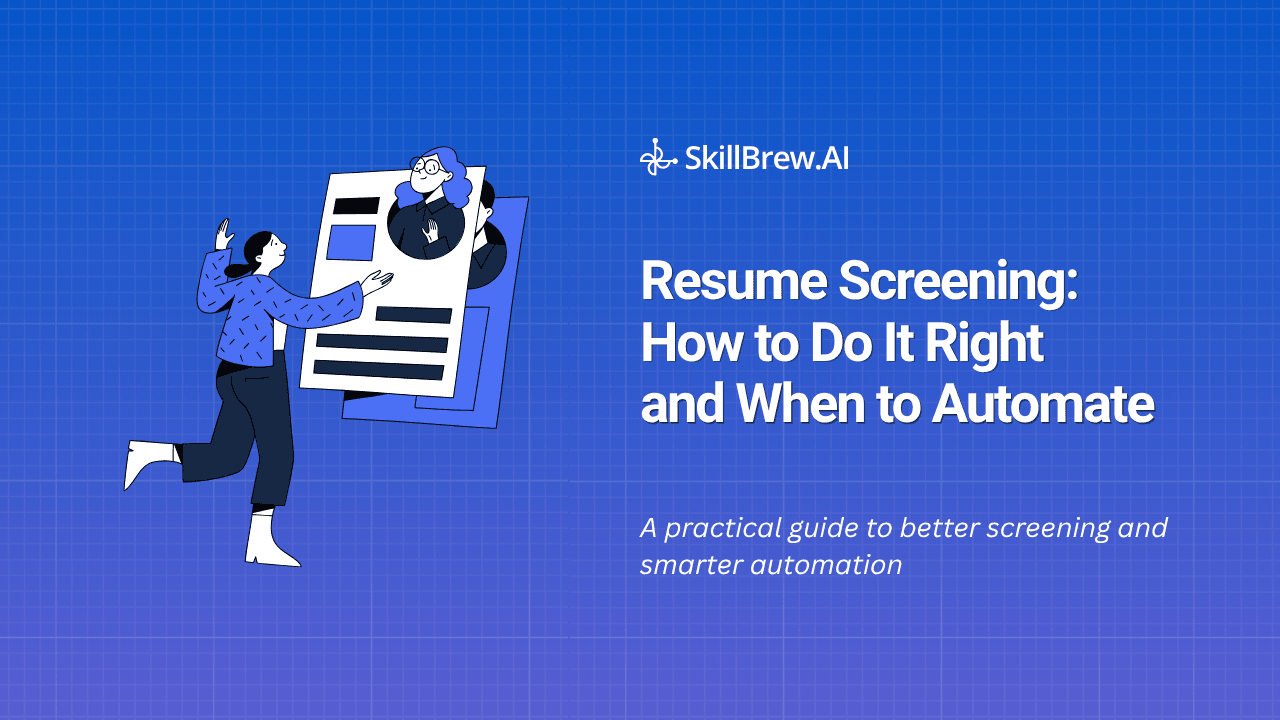
Resume Screening: How to Do It Right and When to Automate
Ask any TA leader where their hiring funnel actually leaks, and resume screening usually comes up first. Not the interview. Not the offer stage. The very first filter, where a strong candidate gets missed because a reviewer was on their two-hundredth resume of the day. This stage decides who gets a shot before a human ever speaks to the candidate. Get it right and your interviewers spend their time on people worth interviewing. Get it wrong and you're either drowning recruiters in volume or los
Ask any TA leader where their hiring funnel actually leaks, and resume screening usually comes up first. Not the interview. Not the offer stage. The very first filter, where a strong candidate gets missed because a reviewer was on their two-hundredth resume of the day.
This stage decides who gets a shot before a human ever speaks to the candidate. Get it right and your interviewers spend their time on people worth interviewing. Get it wrong and you're either drowning recruiters in volume or losing good candidates to keyword mismatches and slow turnaround.
This piece breaks down what a rigorous screening process looks like in practice, gives you a checklist you can start using this week, and lays out exactly when automation is worth adding, instead of just being a trend to follow.
Table of Contents
- What Is Resume Screening: The first filter in your hiring funnel, defined
- Why It Matters: The business case for getting this stage right
- Common Screening Challenges: Where manual review breaks down
- Resume Screening Process: A Step-by-Step Approach: Nine steps from requirements to shortlist
- A Quick Screening Checklist: A reference before you advance a candidate
- When Should You Automate: The signals that tell you it's time
- Manual vs. Automated Screening: A side-by-side comparison
- Benefits of Automating This Stage: What you actually gain
- Limitations to Watch For: What good automation still needs help with
- Balancing AI and Human Judgment: Where each does its best work
- What Comes After Screening: Moving from filtering to validation
- Best Practices Going Forward: Five habits that compound
- Where This Is Headed: The near-term future of the process
- FAQs: Quick answers to common questions
- Conclusion
What Is Resume Screening?
Resume screening is how recruiters evaluate applications against a role's requirements to decide who moves forward. It weighs skills, experience, education, certifications, and role-specific evidence to turn a large applicant pool into a workable shortlist.
It's the entry point to your entire hiring funnel. Whatever happens next, assessments, interviews, offers, is only as good as who this first filter let through.
Why It Matters
A weak first-filter stage doesn't just slow things down. It compounds into every stage after it.
- Time:
Solid screening puts qualified candidates in front of recruiters quickly and filters out the rest before they consume interview slots. - Quality:
Consistent criteria mean the candidates who advance are chosen for reasons that actually predict performance. - Cost:
Open roles cost money every day they stay open. Tightening this stage shortens that window. - Candidate experience:
A slow or opaque process can increase candidate drop-off, particularly when applicants aren't given clear expectations about timelines or next steps. - Downstream decisions:
A disciplined resume screening process hands interviewers a shortlist they trust, not a pile they have to re-vet.
Common Screening Challenges
The same friction points show up across most TA teams, regardless of size.
- Volume:
A single strong listing can pull in hundreds of applications within days. Manual review simply doesn't scale to match. - Unconscious bias:
Recruiters can gravitate toward familiar schools, companies, or career paths, often without realizing it. - Inconsistency:
Without a shared scorecard, two recruiters can review the exact same resume and reach opposite conclusions. - Keyword gaming:
As candidates get better at tailoring resumes to match job description language, keyword-only filtering becomes less reliable. - Missing context:
A resume rarely shows adaptability, communication style, or problem-solving under pressure in enough detail to evaluate them confidently. - Backlog:
Manual review at scale creates a queue, and that queue is frequently the actual reason time-to-shortlist stretches out.
Resume Screening Process: A Step-by-Step Approach
A repeatable resume screening process is what separates disciplined hiring from ad hoc review.
- Define must-have requirements before opening a single application.
- Separate required from preferred qualifications so "nice to have" doesn't quietly disqualify strong candidates.
- Build a scorecard. For a software developer role, you might weight relevant technical experience at 40%, role-specific skills at 25%, project experience at 15%, domain knowledge at 10%, and other preferred qualifications at 10%.
- Prioritize relevant experience over raw years worked.
- Evaluate skills through achievements, not just listed responsibilities.
- Look for role-specific evidence: projects, certifications, portfolio work.
- Score against the scorecard, not gut instinct, to keep the stage defensible.
- Rank and shortlist candidates together rather than reviewing in isolation.
- Track outcomes so your criteria keep improving with real hiring data.
A Quick Screening Checklist
Run every candidate through this before advancing them:
- Do they meet the minimum, non-negotiable qualifications?
- Do they have the required technical skills?
- Is their experience relevant to this specific role?
- Do their projects show practical, applied ability?
- Do achievements show measurable impact, not vague claims?
- Are required certifications or licenses present?
- Does seniority match the level you're hiring for?
- Are there unexplained gaps worth clarifying?
- Does the candidate clear the bar on substance, not just keyword overlap?
When Should You Automate?
Automation should follow need, not the other way around. It earns its place once manual review starts creating real delay or burnout.
- High-volume roles:
Support, sales, retail, and entry-level tracks often generate application volumes that turn manual review into a full-time task by itself. - Rapid growth:
A process built for last year's headcount plan won't hold up under this year's hiring targets. - Distributed hiring:
Screening across regions and time zones is easier with a system that runs continuously. - Lean teams:
Small TA teams get the most leverage from automating repetitive parts of resume screening so they can spend time on interviews instead. - Tight timelines:
In competitive markets, a slow process is often the reason a strong candidate accepts somewhere else first.
Manual vs. Automated Screening
| Factor | Manual Screening | Automated Screening |
| Application volume handled | Limited | High |
| Screening speed | Slower | Faster |
| Consistency | Varies by recruiter | More standardized |
| Recruiter workload | High | Lower |
| Contextual judgment | Strong | Limited without human review |
| Scalability | Limited | High |
| Human oversight needed | High | Should still remain involved |
| Best use case | Low-volume, nuanced hiring | High-volume recruitment |
The point isn't to remove manual review entirely. It's to automate the repetitive layer of resume screening and keep recruiters focused on final judgment.
Benefits of Automating This Stage
Speed. Automated tools move through large applicant pools far faster than manual review.
- Consistency:
Well-designed systems apply the same logic to every application, cutting down on reviewer-to-reviewer variation. - Lighter recruiter load:
Offloading repetitive review frees up time for interviews and candidate relationships. - Broader matching at scale:
Automated tools can weigh skills, experience, and job requirements across large volumes, helping recruiters surface potentially strong candidates more efficiently. - Visibility:
Most automated tools include reporting on drop-off points and how well screening criteria are performing.
Limitations to Watch For
None of this makes automation a solved problem.
- Inherited bias:
Tools trained on historical hiring data can carry forward the same patterns that shaped past decisions. - Human qualities are hard to measure:
Creativity, emotional intelligence, and cultural fit remain difficult for any system to fully capture. - Keyword dependence:
Some tools still lean too heavily on keyword matching, which risks filtering out qualified, unconventional candidates. - Candidate frustration:
A process that rejects too quickly or opaquely can hurt candidate experience and employer brand. - Weak inputs, weak outputs:
Automated resume screening is only as good as the job requirements it's given. Vague or overly restrictive criteria will filter on the wrong signals no matter how capable the tool is.
Balancing AI and Human Judgment
The strongest workflows don't pit automation against recruiters. They divide the work by what each does best.
Automation handles:
- Resume parsing and initial filtering
- Ranking candidates against defined criteria
- Interview scheduling
- Status updates and candidate communication
Recruiters focus on:
- Building candidate relationships
- Interview judgment calls
- Role and team-fit evaluation
- Final hiring decisions
That division is what lets this stage scale without losing the human read a resume alone can't provide.
What Comes After Screening?
Clearing this stage tells you who looks qualified. It can't tell you who can actually perform. That's why resume screening should feed into validation rather than stand in as a hiring decision on its own.
A fuller workflow looks like: screen, assess, interview, decide.
For roles where practical skill matters, a technical assessment after resume screening can validate what a resume can only claim. Instead of relying on background alone, recruiters can test role-specific knowledge and problem-solving ability before investing time in interviews.
SkillBrew.AI can support this stage by generating role-specific technical, behavioral, and cognitive questions from a job description, so this step doesn't cost your timeline extra days.
From there, structured or adaptive interviews add what resumes and tests can't: how a candidate actually reasons through a live follow-up question. Screening, assessment, and interview together give you a far fuller picture before an offer goes out.
Best Practices Going Forward
- Structure the workflow:
A defined process, applied the same way every time, outperforms ad hoc review. - Revisit criteria often:
Roles change. Your scorecard should change with them. - Train for bias:
Even scorecards benefit from periodic bias-awareness training for the people running this stage. - Track the right metrics:
Time-to-shortlist, drop-off rate, and screening accuracy are the real signals your process is working. - Communicate clearly:
Transparent timelines reduce drop-off and protect how candidates talk about your process afterward.
Where This Is Headed
Resume screening is turning into one stage of a connected, AI-assisted hiring workflow rather than a standalone task. Once candidates clear the first filter, more teams are routing them into skills assessments, structured AI interviews, and voice-based screening calls to test what a resume alone can't show.
Skills-based hiring is accelerating that shift, as more organizations weigh practical ability alongside, or ahead of, traditional credentials.
What will matter more is whether screening, assessment, and interview data connect into one coherent picture of a candidate, with people still making the final call.
FAQs
Q1. What is the difference between resume screening and resume parsing?
Resume parsing pulls structured data, like contact details, skills, or job titles, out of a resume. Screening is the evaluation step after that, where the data is judged against role requirements to decide who advances.
Q2. How long should resume screening take per candidate?
There's no universal benchmark. The right amount of time depends on the role's complexity, application volume, and screening criteria. If manual review is creating a backlog or delaying shortlists, it's worth tightening the scorecard or considering automation for the first pass.
Q3. Can automation replace recruiters entirely?
No. Automated resume screening handles the repetitive first pass well, but judgment calls, especially on fit and borderline candidates, still benefit from recruiter oversight.
Q4. Does screening software eliminate bias?
Not on its own. A well-designed system can reduce reviewer-to-reviewer inconsistency, but bias in training data or scoring criteria can still carry through. Outcomes need ongoing review.
Q5. What should a scorecard include?
Weighted categories tied to what actually predicts performance in the role: relevant experience, role-specific skills, project or portfolio evidence, domain knowledge, and required certifications.
Q6. Is keyword matching enough on its own?
No. It misses candidates who describe skills differently than the posting and can be gamed by candidates tailoring resumes to match listed language. It works best as one input inside a broader scorecard for resume screening as a whole.
Conclusion
There's no single right ratio of manual to automated resume screening. It depends on your hiring volume, role complexity, and team size.
What matters is having a screening process that is structured, consistent, and focused on the signals that actually matter for the role. Start by defining your criteria, standardize how candidates are evaluated, and automate the repetitive parts when manual review starts creating a bottleneck.
SkillBrew.AI helps recruiters take that approach further by connecting screening with role-specific assessments and structured interviews. Instead of relying on a resume alone, recruiters can screen candidates against job requirements and then validate their technical, behavioral, and cognitive skills before moving them into interviews.
The goal isn't to remove recruiters from the process. It's to give them better signals earlier, so they can spend less time filtering resumes and more time making informed hiring decisions.
Want to see how it works in practice? Book a demo with SkillBrew.AI and explore how AI-assisted screening and assessment can fit into your hiring workflow.
See AI-powered hiring in action
Discover how SkillBrew helps hiring teams cut time-to-hire by 60% with skill-validated assessments and AI-ranked shortlists.
Book a free demoNo commitment required · 30 minutes
Continue reading
View All Posts