Technical Screening
Skills-Based Hiring: How to Redesign Your Screening Process
Your screening process is filtering out the wrong people. Not because your team isn't working hard. It's because the criteria it runs on were built for a different era of hiring, one where a degree from the right school or a stint at the right company was a reasonable proxy for ability. It isn't anymore. Skills-based hiring screening fixes this by shifting the filter from credentials to demonstrated capability. By the end of this post, you'll have a concrete framework for auditing your current
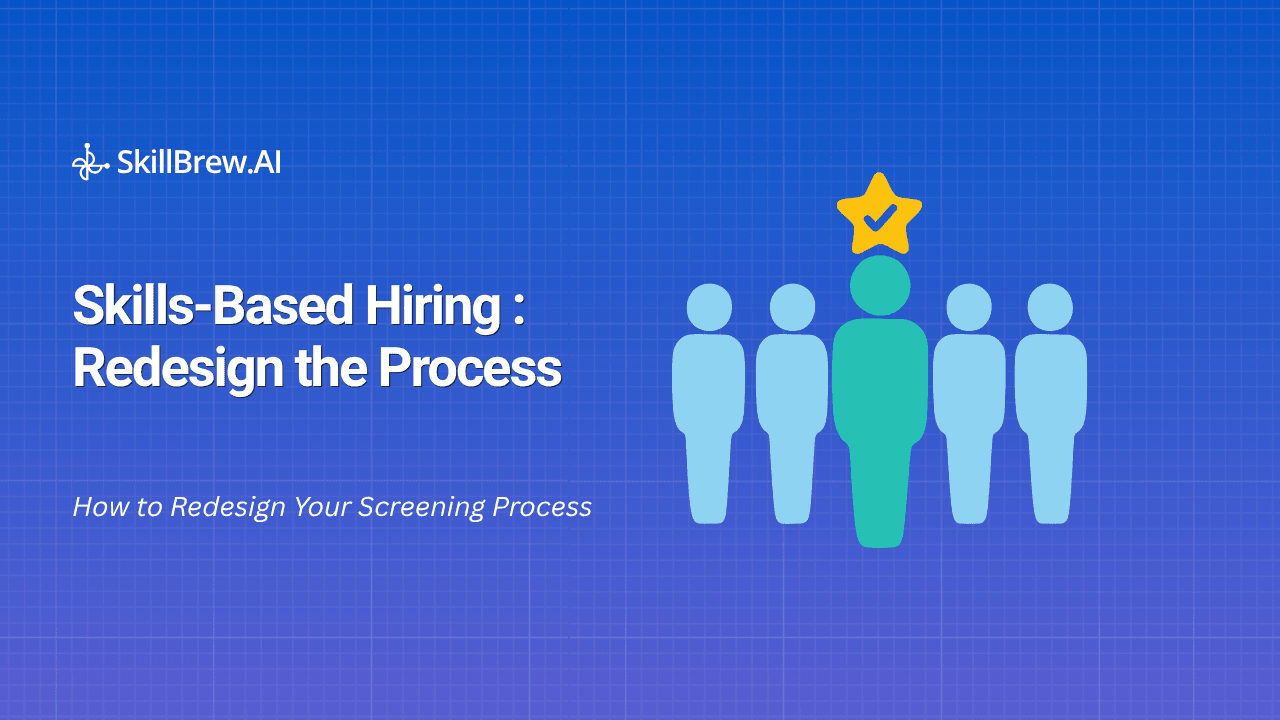
Your screening process is filtering out the wrong people. Not because your team isn't working hard. It's because the criteria it runs on were built for a different era of hiring, one where a degree from the right school or a stint at the right company was a reasonable proxy for ability. It isn't anymore.
Skills-based hiring screening fixes this by shifting the filter from credentials to demonstrated capability. By the end of this post, you'll have a concrete framework for auditing your current screening process, identifying where it's losing you good candidates, and rebuilding it around skills that actually predict job performance.
This isn't about removing rigour. It's about applying it to the right things. Below is a practical, step-by-step look at what skills-based hiring screening involves, where most screening processes fall short of it, and how to rebuild yours around it.
Table of Contents
- What Skills-Based Hiring Screening Actually Means: the shift from credential-first to capability-first evaluation
- Where Most Screening Processes Break Down: the three failure points before candidates ever reach interview
- How to Audit Your Current Screening Process in One Week: a four-step diagnostic you can run this week
- Redesigning Your Screening Process Around Skills: the three-layer model for filtering at scale
- What Good Skills-Based Screening Looks Like in Practice: a real redesign and the numbers it produced
- The Questions to Ask Any Assessment Vendor: what separates a working tool from a demo
- The Metrics That Tell You Your Redesign Is Working: four numbers to track after rollout
- The Shift Is Process, Not Just Technology: why tools alone don't fix screening
What Skills-Based Hiring Screening Actually Means
Skills-based hiring screening means evaluating candidates on what they can do before you evaluate them on what they've done. The distinction matters more than it sounds.
Traditional screening is retrospective. It asks: where did this person work? How long were they there? Did they tick the required boxes on the job description? Skills-based hiring screening is prospective. It asks: can this person do the specific things this role requires? That reframe changes almost every decision in your process: which assessments you use, when you use them, and how much weight you give to a CV that looks impressive on paper.
For TA leaders managing pipelines at scale, this also matters commercially. Resume-first screening at 200 applicants is roughly 100 hours of calendar time before a single qualified candidate has been verified. Skills-based hiring screening, where a structured technical screening or role-relevant assessment runs before or alongside CV review, cuts that number significantly, because you're removing unqualified candidates faster and earlier.
The model isn't radical. It's structural: define the skills the role requires, build an assessment that measures those skills specifically, and use the results to rank your pipeline before your recruiters spend time on any individual candidate.
Where Most Screening Processes Break Down
The failure point isn't usually the interview. It's everything before it. Most screening processes break down in three places, and each one is a place skills-based hiring screening is built to fix.
1. Criteria drift
Job descriptions accumulate requirements over time. A role that needed three things two years ago now needs twelve, many of which are either untestable at screening stage or irrelevant to day-one performance. When your screening criteria list is longer than your interviewers can hold in their heads, no one is actually screening against it.
2. The CV as a proxy for skill
Recruiters who screen 40 CVs in a morning are pattern-matching, not evaluating. They're looking for logos, titles, and tenure, all of which correlate loosely with skill but are heavily influenced by access and opportunity. This is where capable candidates from non-traditional backgrounds get filtered out, and where your pipeline starts to look like everyone else's. Skills-based hiring screening removes that proxy entirely.
3. Technical screening arriving too late
Many organisations run technical assessments after two or three interview rounds. By that stage, recruiters and hiring managers have already invested hours in candidates who may not meet the bar. Moving technical screening earlier, even as a short automated assessment immediately post-apply, gives you a skills signal before your team commits time to the conversation.
How to Audit Your Current Screening Process in One Week
Before you rebuild anything, you need to know where the gaps are. A one-week audit across four data points gives you enough to act on before you commit to a full skills-based hiring screening rollout.
Step 1: Pull your drop-off data by stage
Where are candidates dropping out of your funnel? If the steepest drop is between application and first screen, you have a volume problem or a friction problem. If it's between first screen and second interview, your screening criteria aren't matching the hiring manager's expectations. The data tells you which problem you're actually solving.
Step 2: Map the skills required to day-one performance
Get 30 minutes with the hiring manager and ask one question: what does a good person in this role do in their first 90 days? The answers will cluster around three to five concrete capabilities. Those are your screening criteria. Not the job description: the day-one performance list.
Step 3: Check whether your current process measures those skills
Map your current screening stages against the skills list. If a skill isn't assessed before the final interview, it isn't part of your screening process. It's part of your offer decision. Move it earlier or build an assessment that covers it at scale.
Step 4: Measure time spent per stage
Add up recruiter hours per stage, including CV review, phone screens, and coordination. For most teams running 200+ applicants, CV review alone runs 80-120 hours. That's the number skills-based hiring screening needs to beat, and in most implementations, it does, because automated assessments handle the first-pass filter before a recruiter opens a single CV.
Redesigning Your Screening Process Around Skills
A redesigned skills-based hiring screening process runs in three layers. Each layer eliminates candidates who don't meet the bar, so every subsequent layer is smaller and higher quality.
Layer 1: Automated skills assessment at application
The first filter is a role-relevant assessment that runs immediately after a candidate applies. For technical roles, this is a coding or problem-solving task. For non-technical roles, it's a work sample, written scenario, or structured situational exercise. It should take 20-30 minutes, be specific to the role, and produce a ranked output your recruiters can act on without reviewing every response manually.
The goal is not to eliminate candidates aggressively. It's to sort your pipeline by demonstrated capability before anyone on your team spends time on it. Candidates who score above your threshold move forward; everyone else gets a fast, respectful response.
Layer 2: Structured technical screening
For candidates who pass Layer 1, a structured technical screening gives your recruiters or hiring managers a consistent basis for comparison. The key word is structured: the same questions, the same scoring rubric, applied the same way across every candidate. Unstructured phone screens produce inconsistent data and let interviewer bias drive decisions. Structured technical screening produces a dataset.
This layer is where many TA teams have the most room to improve. If your technical screening notes are qualitative, phrases like "seemed strong" or "good communication," you're not running a screening process, you're running a gut check. Replace qualitative notes with scored criteria tied to the day-one performance list from your audit.
Layer 3: Skills-verified interview shortlist
By the time a candidate reaches an interview in this model, they have already demonstrated the core skills the role requires through skills-based hiring screening. The interview isn't used to discover capability. It's used to assess fit, working style, and the things that can't be measured in an assessment. That shift changes how your interviewers spend their time, and it significantly reduces the rate of late-stage pipeline drops.
What Good Skills-Based Screening Looks Like in Practice
A mid-sized technology company running 300+ applications per engineering role redesigned their screening process in Q3 last year. Previously, their recruiters spent an average of 12 minutes per CV across an initial shortlist of 60 candidates, roughly 12 hours of recruiter time before a single technical screen ran.
After switching to skills-based hiring screening, automated coding assessment at application, structured technical screen for the top 20%, their time-to-shortlist dropped by 65%. More importantly, the shortlist quality improved: the rate of candidates who passed the technical screen but failed the final interview dropped from 38% to 11%, because the screening process was now filtering on the same criteria the interviewers were evaluating.
The change wasn't primarily about technology. It was about agreeing upfront on what "qualified" meant and building a screening process that measured it consistently. The tools made skills-based hiring screening scalable.
The Questions to Ask Any Assessment Vendor
If you're evaluating platforms to support your skills-based hiring screening process, these are the questions that separate tools that work at scale from tools that sound good in a demo.
- Can assessments be customised to the specific skills on my day-one performance list, or am I choosing from a fixed library?
- Does the platform produce ranked outputs my recruiters can filter without reviewing every response manually?
- What does the candidate experience look like on mobile? Completion rates drop significantly when assessments aren't mobile-optimised.
- How does the platform handle cheating or AI-assisted responses? What controls exist, and how are results flagged?
- What data do I get on assessment performance over time: completion rates, score distributions, correlation with hire outcomes?
- Can it integrate with my ATS, or does it create a separate workflow my recruiters have to manage manually?
A vendor who can't answer the last question, the ATS integration point, is adding process, not removing it. Skills-based hiring screening only works at scale when it runs inside your existing workflow, not alongside it.
The Metrics That Tell You Your Redesign Is Working
A redesigned screening process in recruitment produces measurable changes within the first two or three hiring cycles. If you're not seeing movement in these numbers, your skills-based hiring screening redesign isn't complete. Track them by hiring cycle, not by quarter, so you can see whether skills-based hiring screening is actually changing outcomes or just adding a new step to the same process.
| Metric | What it tells you | Target |
| Time-to-shortlist | Business days from application close to a ranked shortlist your recruiters can act on | 40-60% reduction in the first cycle |
| Late-stage pass rate | Percentage of candidates who pass technical screening but fail final interview or offer | Below 25%; higher means criteria are misaligned |
| Recruiter hours per shortlist | Total recruiter time from application to shortlisted candidate | Should drop after redesign, not rise |
| Pipeline diversity at shortlist | Whether shortlist demographics shift once credential proxies are removed | Should shift; flat numbers mean bias elsewhere |
The Shift Is Process, Not Just Technology
Skills-based hiring screening fails when it's implemented as a tool purchase without a process redesign. An assessment platform added to a credential-first workflow doesn't change what your pipeline produces. It just adds a step. The redesign has to come first: define the skills, restructure the stages, align the criteria between screening and interview. The technology makes it scalable.
Most TA leaders already know their screening process isn't working the way it should. Time-to-shortlist is longer than it needs to be, late-stage drops are higher than the data should allow, and recruiter time is concentrated in stages that don't produce useful signal. Skills-based hiring screening fixes the structure, and the structure is what everything else runs on.
Ready to move your technical screening earlier?
If your team is losing 80-120 hours per role to CV review before a single skill has been verified, SkillBrew.AI can put a ranked, skills-verified shortlist in your recruiters' hands before they open a single application. See how it works with your pipeline. Book a 20-minute walkthrough.
See AI-powered hiring in action
Discover how SkillBrew helps hiring teams cut time-to-hire by 60% with skill-validated assessments and AI-ranked shortlists.
Book a free demoNo commitment required · 30 minutes
Continue reading
View All Posts