Recruitment Automation & Workflow
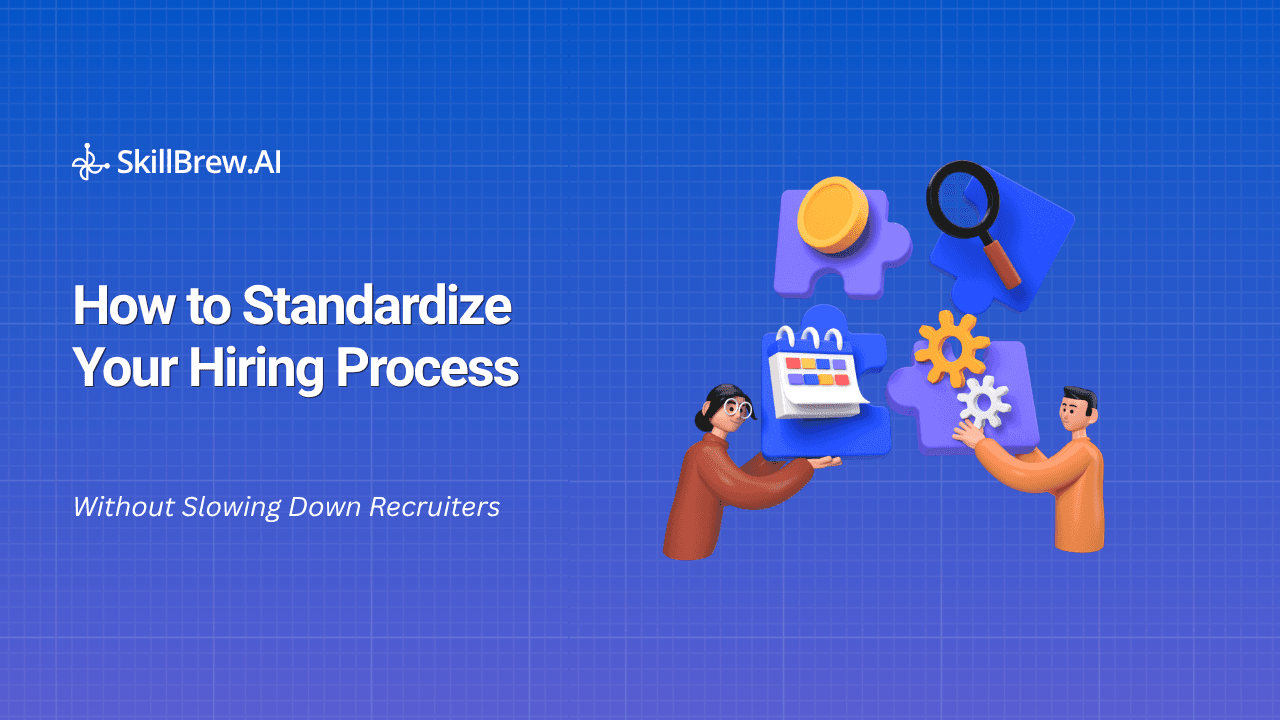
How to Standardize Your Hiring Process Without Slowing Down Recruiters
Recruiters are asked to move faster every quarter, but moving faster usually makes hiring less consistent. Two recruiters can screen the same job requisition and reach two different conclusions about the same candidate. One relies on a 15 minute call and a gut check. The other builds a full scorecard and still misses details the first recruiter caught by instinct. Neither recruiter is doing anything wrong. They just don't have a shared process to work from. This is what happens without a plan

Recruiters are asked to move faster every quarter, but moving faster usually makes hiring less consistent. Two recruiters can screen the same job requisition and reach two different conclusions about the same candidate. One relies on a 15 minute call and a gut check. The other builds a full scorecard and still misses details the first recruiter caught by instinct.
Neither recruiter is doing anything wrong. They just don't have a shared process to work from.
This is what happens without a plan to standardize the hiring process operations: interview questions vary by interviewer, feedback gets recorded in whatever format someone feels like using that day, and candidates move through different stages depending on who happens to be managing the role.
The fix isn't to make every recruiter work identically. It's to build a reliable foundation that still leaves room for recruiters to adapt to different roles, teams, and candidates. When you standardize the hiring process activities the right way, it improves consistency, cuts repetitive work, strengthens hiring decisions, and makes it possible to scale recruitment without the process collapsing under its own weight.
Table of Contents
- What It Means to Standardize the Hiring Process: the difference between a framework and a script.
- Why Hiring Teams Drift Into Inconsistency: where variation usually creeps in.
- What a Standardized Hiring Process Actually Buys You: consistency, speed, and measurable data.
- What to Standardize (And What Not To): the two-layer model.
- Before and After: What Changes: a side-by-side workflow comparison.
- How to Standardize Without Adding More Work: a five-step rollout.
- How Automation Supports Standardization: where AI fits, and where it doesn't.
- How to Know If Standardization Is Working: what to track after rollout.
- Common Mistakes to Avoid: pitfalls that undo the effort.
- Standardize Without Losing Recruiter Flexibility: where a platform like SkillBrew.AI fits in.
- FAQs: quick answers to common questions.
- Final Checklist: everything you need before rollout.
What It Means to Standardize the Hiring Process
To standardize the hiring process steps is to define a consistent set of criteria, workflows, and expectations that every recruiter and hiring manager follows.
In practice, that means agreeing on:
- Which stages every candidate goes through
- What information recruiters collect during screening
- Which skills get evaluated for a given role
- Which interview questions stay consistent
- How interviewers record feedback
- When candidates move between stages
- How hiring managers approve or reject candidates
- Which communications are automated
None of that means every role gets an identical process. A software engineer and a sales executive need completely different assessments. A campus hiring drive might involve hundreds of candidates in a week, while an executive search might involve five people over three months.
A working hiring workflow creates shared principles first, then lets role-specific detail sit on top of that foundation. Think framework, not script. This is really what it means to standardize the hiring process decisions without turning recruitment into a rulebook.
Why Hiring Teams Drift Into Inconsistency
Inconsistency rarely shows up as a single bad decision. It builds up from small, reasonable choices made independently by different people.
Candidates get evaluated on different terms.
One recruiter's 15 minute phone screen and another's 30 minute deep dive produce feedback that isn't actually comparable, even when both are trying to assess the same thing.
Hiring managers work with incomplete information.
When every interview produces feedback in a different format, hiring managers spend extra time asking recruiters to translate what "good candidate" or a two-line note actually means.
Recruiters redo the same work repeatedly.
Without a defined hiring workflow, recruiters manually build interview stages, chase reminders, update candidate statuses, and repeat the same information to different stakeholders.
The process breaks as volume grows.
A setup that works fine for five recruiters can fall apart once the team hits 20 or 50, or once a single requisition pulls in thousands of applicants. This is usually the moment teams realize they need to standardize the hiring process activities before volume forces the issue.
This is the gap a plan to standardize the hiring process operations is meant to close.
What a Standardized Hiring Process Actually Buys You
A standardized hiring process doesn't have to trade consistency for speed. Done right, it improves both. The easiest way to see the payoff is to look at what changes when you standardize the hiring process steps across every requisition instead of leaving them to individual recruiters.
More consistent evaluation.
Candidates get assessed against the requirements of the role, not the mood or habits of whoever happens to be screening them that day.
Faster ramp for new recruiters.
New hires follow established workflows, templates, and scorecards instead of learning the process through trial and error.
Cleaner collaboration.
Recruiters and hiring managers know exactly what information to expect at each stage, which cuts down on back-and-forth.
A more predictable candidate experience.
Clear stages and timelines mean candidates get consistent communication instead of guessing where they stand.
Metrics that actually mean something.
Once recruitment follows a consistent structure, you can reliably track:
- Time to hire
- Time spent at each stage
- Interview-to-offer ratio
- Candidate drop-off
- Screening pass rates
- Offer acceptance rates
That data becomes much more useful when the process generating it is consistent in the first place. This is one of the clearest business reasons to standardize the hiring process reporting: the metrics only become trustworthy once the process producing them is consistent.
What to Standardize (And What Not To)
The mistake most teams make when they try to standardize the hiring process operations is assuming everything needs to look identical. It doesn't. When you standardize the hiring process stages correctly, you're building a two-layer model: a standardized core, and a customizable layer on top.
Standardize:
- Hiring stages and their entry and exit criteria
- Evaluation criteria and scorecard structure
- Required information collected at each stage
- Approval rules and who signs off
- Candidate communication standards
- Reporting format
Don't over-standardize:
- Recruiter conversation style
- Candidate relationship building
- Role-specific interview questions
- Interview panel composition
- Screening thresholds tuned to a specific role
That distinction is really the thesis of this entire approach: ways to standardize the hiring process criteria without removing recruiter judgment. A customizable hiring workflow built on a standardized core gives recruiters structure without stripping out their judgment.
Applied to a scorecard, that structure looks like this:
| Competency | Rating | Notes |
| Technical skills | 1–5 | Evidence from assessment |
| Communication | 1–5 | Interview observations |
| Problem solving | 1–5 | Scenario response |
| Role-specific knowledge | 1–5 | Interview performance |
| Overall recommendation | 1–5 | Final assessment |
Every recruiter fills in the same five rows. What goes in the "notes" column still depends on the role and the interviewer's judgment.
Before and After: What Changes
The clearest way to see what it means to standardize the hiring process steps is to line up the two workflows side by side, and to isolate standardization from automation so it's clear which one is doing the work.
Before standardization:
Application → recruiter-defined screening → variable interview → unstructured feedback → manual decision
After standardization:
Application → defined screening criteria → structured interview → standard scorecard → defined decision criteria
Same number of stages, same amount of automation (none yet) on both sides. The only thing that changes is that every candidate now gets screened against the same criteria, interviewed with the same structure, scored on the same scorecard, and moved to a decision using the same rules, regardless of which recruiter is running the requisition.
Automation is a separate lever. Once you standardize the hiring process steps, automation can take that same structure and make it faster: automated scheduling, automated assessment delivery, automated follow-up. But automation applied to an inconsistent process just makes the inconsistency happen faster. Standardize first, then automate.
How to Standardize Without Adding More Work
Standardization only works if recruiters actually use it. If the new process means filling out a dozen extra fields and manually updating every stage, adoption dies fast. Here's how to standardize the hiring process activities in five steps without adding to anyone's workload.
Step 1: Map the current workflow
Before changing anything, document how hiring actually happens today. Where does a candidate enter the process? Who screens them, and against what criteria? Which interviews get run, and who gives feedback? Where do candidates typically get stuck? This gives you a baseline to measure against before you standardize the hiring process steps.
Step 2: Separate the non-negotiables from the flexible parts
Non-negotiable: candidate eligibility criteria, core screening criteria, feedback format, required approval stages, communication standards.
Flexible: number of interview rounds, role-specific questions, assessment type, interview panel, technical evaluation criteria.
Step 3: Build reusable templates
Templates cut down the manual work recruiters do on every requisition: job descriptions, screening questions, scorecards, candidate emails, interview invitations, assessment instructions, hiring manager updates.
Step 4: Build role-specific workflows on the shared foundation
Instead of one universal process, build workflow templates by hiring category:
Engineering: Application → screening → technical assessment → technical interview → hiring manager interview → offer
Sales: Application → recruiter screening → communication assessment → hiring manager interview → final interview → offer
Campus hiring: Application → eligibility screening → aptitude assessment → AI interview → shortlist → final interview → offer
Each one follows the same organizational standards while adapting to what the role actually needs.
Step 5: Automate the repetitive parts
Recruiters shouldn't spend time on tasks software handles better once you standardize the hiring process activities enough to automate them. Hiring workflow automation can take over candidate status updates, interview scheduling, assessment invitations, reminders, candidate emails, feedback collection, score calculations, and stage transitions. The goal isn't to automate recruiters out of the process. It's to strip out the administrative work around them.
How Automation Supports Standardization
Without automation, recruiters have to remember which steps apply to which role, every time. With a structured system built to standardize the hiring process decisions, the workflow enforces itself.
Take a candidate applying for a technical role. The system can automatically check eligibility criteria, move qualified candidates into screening, send the assessment, record results, trigger the next interview stage, notify the recruiter when action is needed, collect interviewer feedback, and update the candidate's status. None of that requires a recruiter to remember a checklist.
Recruitment process automation is what makes this predictable. Every candidate follows the correct sequence regardless of who's running the requisition or how busy they are that week.
AI adds another layer here, mainly by helping recruiters summarize interviews, surface relevant skills, and organize candidate information against predefined criteria. Worth being precise about what that means in practice: AI supports the evaluation, it doesn't make the hiring decision. Recruiters still make the final call. That distinction matters, especially because it's the difference between a tool that saves time and a tool nobody trusts.
How to Know If Standardization Is Working
Rolling out a plan to standardize the hiring process steps isn't the finish line. Track the same metrics before and after rollout to confirm it's actually doing what it's supposed to.
| Metric | What to look for |
| Time to hire | Is the process getting faster? |
| Time in stage | Where are candidates getting stuck? |
| Candidate drop-off | Are the new steps causing friction? |
| Interview completion | Are interviewers actually following the workflow? |
| Recruiter workload | Are manual tasks going down? |
| Hiring manager satisfaction | Is feedback getting easier to use? |
If most of these move in the right direction within a hiring cycle or two, the process is working. If time in stage or drop-off gets worse, that's usually a sign the new process added friction somewhere instead of removing it, and it's worth revisiting before rolling it out further.
Common Mistakes to Avoid
Forcing every role into the same workflow. The goal is to standardize the hiring process criteria, not erase differences that actually matter.
Stacking too many approval steps. If every candidate needs multiple sign-offs, the process gets slower, not faster.
Standardizing without measuring. You need data to know whether the new process is actually working.
Automating a broken process. Automation won't fix unclear criteria or unnecessary stages. Simplify first, then automate.
Ignoring recruiter feedback. Recruiters run this process daily. Their feedback surfaces unnecessary steps and automation gaps faster than any audit will.
Standardize Without Losing Recruiter Flexibility
Most of what gets standardized here, screening criteria, structured interviews, scorecards, feedback formats, candidate progression, is exactly the layer SkillBrew.AI is built to handle for teams that want to standardize the hiring process operations without adding headcount.
SkillBrew.AI's HireFlow gives recruiters a shared hiring workflow with Kanban-based candidate tracking, AI resume shortlisting, and automated WhatsApp and email communication, so every requisition follows the same structure without a recruiter having to rebuild it manually. On top of that shared foundation, AI Interviews and Technical Assessments still adapt to the specific role: an adaptive, resume-aware interview avatar asks role-relevant follow-up questions, and assessments get generated directly from the job description in minutes. BrewShield runs underneath both to help keep evaluation criteria consistent across candidates, regardless of who set up the requisition.
The standardized layer stays fixed. The role-specific layer stays flexible. That's the model this article has been describing throughout: ways to standardize the hiring process operations without losing recruiter flexibility, just applied to a specific platform instead of a general framework.
FAQs
Q1. What does it mean to standardize the hiring process?
It means defining a consistent set of stages, evaluation criteria, and communication standards that every recruiter follows, while still allowing role-specific questions and assessments to vary.
Q2. Why should companies standardize their hiring process?
Inconsistent processes make candidates hard to compare, slow down hiring managers, and create repetitive manual work for recruiters. Choosing to standardize the hiring process operations fixes all three without requiring more headcount.
Q3. How can recruiters standardize hiring without slowing down?
The key is to standardize the hiring process stages selectively: separate the non-negotiable parts (screening criteria, scorecards, approvals) from the flexible parts (role-specific questions, panel composition), then automate the repetitive administrative work in between.
Q4. What parts of the hiring process should be standardized?
When you standardize the hiring process elements, focus on hiring stages, screening criteria, scorecards, required information, approval rules, and candidate communication. Role-specific questions, interview style, and screening thresholds should stay flexible.
Q5. Can hiring workflows be standardized while remaining customizable?
Yes. A customizable hiring workflow built on a standardized core is the model most high-volume teams end up using: fixed structure underneath, role-specific detail on top.
Final Checklist
Before you standardize the hiring process steps company-wide, confirm you have:
- Clearly defined hiring stages
- Standard screening criteria
- Role-specific evaluation criteria
- Consistent interview scorecards
- Reusable candidate communication templates
- Clear ownership for each hiring stage
- Defined approval rules
- Customizable workflows for different roles
- Automation for repetitive administrative tasks
- Recruitment metrics and reporting
- A process for collecting recruiter feedback
Final Thoughts
The point of choosing to standardize the hiring process activities was never to add more rules for recruiters to follow. It's to remove unnecessary decisions and repetitive work from their day, so the time they do spend goes toward the parts of the job that actually need human judgment: understanding candidates, working with hiring managers, and making better calls.
It's to make the right process the easiest process to follow.
Want to see what a standardized hiring workflow looks like in practice? Book a demo with SkillBrew.AI and see how HireFlow, AI Interviews, and Technical Assessments work together on a shared foundation.
See AI-powered hiring in action
Discover how SkillBrew helps hiring teams cut time-to-hire by 60% with skill-validated assessments and AI-ranked shortlists.
Book a free demoNo commitment required · 30 minutes
Continue reading
View All Posts