AI Assessment
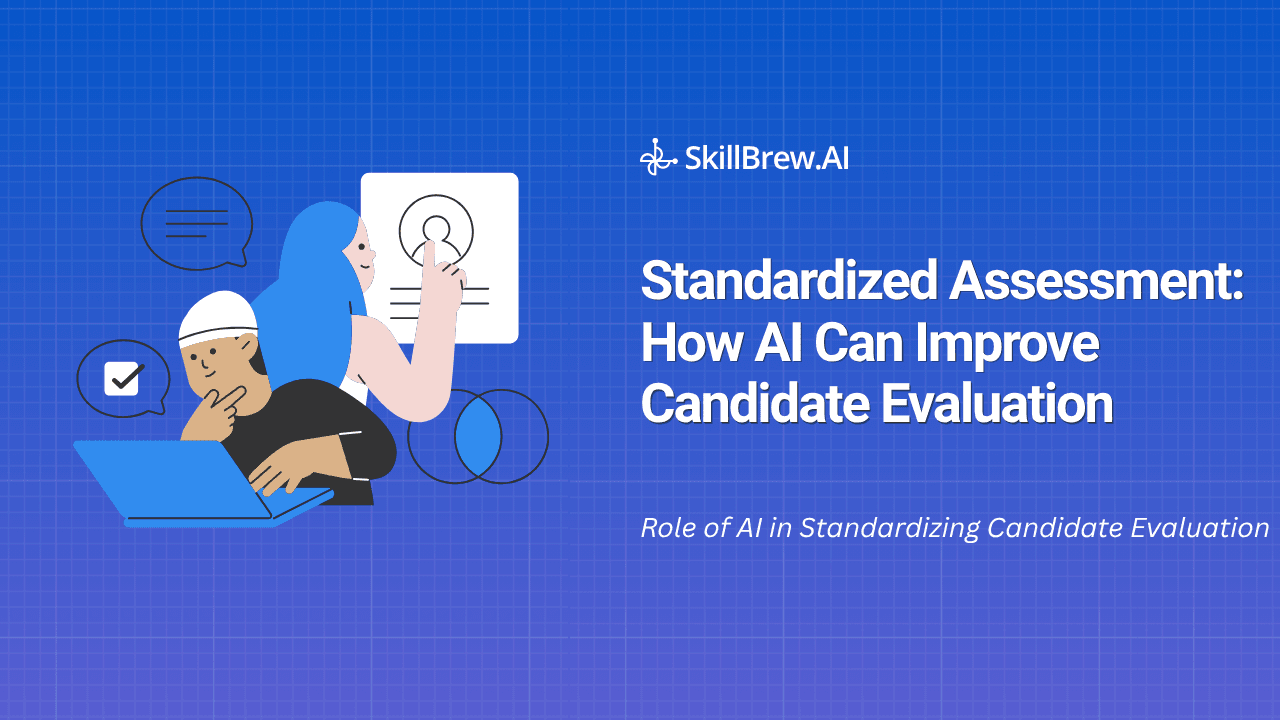
Standardized Assessment: How AI Can Improve Candidate Evaluation
Two recruiters can interview the same candidate and walk away with completely different conclusions. One focuses on technical depth. Another prioritizes communication. A hiring manager weighs prior experience more heavily than either of them. The problem usually isn't that someone evaluated the candidate incorrectly. It's that everyone used a different standard. A standardized assessment helps address this by giving candidates comparable questions, instructions, and scoring criteria, so resul

Two recruiters can interview the same candidate and walk away with completely different conclusions.
One focuses on technical depth. Another prioritizes communication. A hiring manager weighs prior experience more heavily than either of them.
The problem usually isn't that someone evaluated the candidate incorrectly. It's that everyone used a different standard.
A standardized assessment helps address this by giving candidates comparable questions, instructions, and scoring criteria, so results can actually be compared side by side. Done well, it doesn't flatten candidates into numbers. It gives recruiters a shared, job-relevant basis for judgment, and AI is what makes that basis practical to run at scale.
Key Takeaways
- A standardized assessment gives recruiters a consistent framework for comparing candidates.
- Standardization should focus on evaluation criteria and process, not identical questions for every role.
- Assessment content should map to competencies that are actually relevant to the job.
- AI can generate, score, and organize assessments consistently across large candidate pools.
- Human review still matters. A score is evidence, not a verdict.
Table of Contents
- What Is a Standardized Assessment: the basics and where it fits in hiring
- Why Candidate Evaluation Becomes Inconsistent: the failure modes standardization fixes
- What Should Be Standardized: criteria, scoring, conditions, and reporting
- Standardized Does Not Mean Identical: consistency without irrelevance
- Before and After: What Changes With a Standardized Assessment
- How AI Supports Standardized Evaluation: four mechanisms, and where AI's limits are
- How to Build a Standardized Candidate Evaluation Process: a six-step framework
- Common Mistakes to Avoid: pitfalls that undermine standardization
- Practical Checklist for Recruiters: a pre-launch review
- FAQs: quick answers on the topic
- Conclusion
What Is a Standardized Assessment?
A standardized assessment evaluates candidates using consistent procedures: the same instructions, comparable questions, and predefined scoring rules. The exact level of consistency varies by company, but the goal is always the same: make results easier to compare.
A well-designed standardized assessment typically ensures that candidates:
- Receive the same instructions
- Get the same amount of time
- Are evaluated against the same competency framework
- Answer questions mapped to the same underlying skills
- Are scored using criteria set before anyone sees a candidate response
None of this means every candidate answers identical questions. A software engineer and a sales representative need different skills, so the assessment for one role will look different from another. What stays constant is the process: define competencies, choose relevant methods, score against a fixed rubric, and report results the same way for everyone.
Why Candidate Evaluation Becomes Inconsistent
Hiring involves people, and people interpret the same evidence differently. A few patterns show up repeatedly.
- Different interviewer priorities.
One interviewer weighs technical depth. Another weighs communication or customer-facing ability. Without shared criteria, two interviewers can reach opposite conclusions about the same candidate. - Unstructured scoring.
Notes like "strong candidate," "seems like a good fit," or "not experienced enough" may be useful, but they're impossible to compare when nobody has defined what "strong" means. - Different questions for different candidates.
If one candidate gets an easy technical question and another gets a hard one, recruiters aren't actually holding comparable evidence, even if both "passed the interview." - Overreliance on interviews.
A candidate's ability to talk about their experience isn't the same as their ability to perform the task. A structured assessment adds a second, independent source of evidence.
What Should Be Standardized?
The most useful approach standardizes the parts of the process where consistency matters most, and leaves the rest flexible.
1. Assessment criteria
Define what good performance looks like before anyone is evaluated. For a data analyst, that might be data interpretation, SQL ability, analytical reasoning, and communication. For customer support, it might be problem-solving, product understanding, and customer judgment.
2. Scoring rules
Every competency needs a rubric decided in advance, not invented after seeing a candidate's answer. For a debugging exercise, a simple 1–5 scale might look like this:
| Score | What it looks like |
| 1 | Cannot identify the underlying issue |
| 2 | Identifies a symptom but not the root cause |
| 3 | Identifies the issue and proposes a workable fix |
| 4 | Identifies the root cause and explains the reasoning |
| 5 | Identifies the root cause, explains the reasoning, and proposes a robust, tested solution |
Competencies also shouldn't all count equally. An assessment for a software engineer might weight coding at 35%, problem-solving at 25%, debugging at 20%, technical reasoning at 15%, and communication at 5%. Weighting lets a hiring team reflect which skills actually matter most for the role, instead of treating every competency as equally important by default.
3. Assessment conditions
Where practical, keep conditions consistent: time limits, instructions, submission requirements, and evaluation criteria. This removes noise that has nothing to do with candidate ability.
4. Reporting
Results should land in the same format for every candidate. A structured report with fixed categories is far easier to compare than one recruiter's paragraph next to another recruiter's raw score.
Standardized Does Not Mean Identical
The biggest misconception about a standardized assessment is that every candidate must see exactly the same content. They don't.
Imagine a company hiring backend developers, data analysts, sales representatives, and customer support specialists at the same time. Using one identical test for all four roles would be consistent, but not relevant. A debugging exercise tells you nothing about a sales candidate's ability to handle an objection.
What can stay fixed is the framework: job requirements, then competencies, then assessment, then scoring, then candidate report. The content changes by role. A backend developer completes a debugging task. A data analyst works through a dataset. A sales candidate responds to a prospect objection. A customer support candidate handles a realistic customer scenario. The framework is standardized. The evidence is role-specific.
This only works, though, if the underlying content is actually connected to the job. An assessment that's consistent but irrelevant (testing memorization for a customer support role that really needs judgment and empathy) is consistent for its own sake. Consistency is only valuable when it's measuring the right thing. That's worth checking before scaling any assessment, not after.
Before and After: What Changes With a Standardized Assessment
Without a shared framework, feedback tends to look like this:
Recruiter A: "Strong candidate. Good communication and seems technically capable."
Recruiter B: "Average candidate. Lacks enough experience."
There's no way to compare these two notes, because there's no shared standard behind either one.
With a standardized assessment, the same candidate produces something like this instead:
| Competency | Weight | Score |
| Technical reasoning | 30% | 4/5 |
| Problem-solving | 25% | 4/5 |
| Communication | 20% | 3/5 |
| Role-specific knowledge | 25% | 5/5 |
Now a recruiter can see exactly why the candidate scored where they did, and compare that scorecard against every other candidate evaluated against the same rubric. That's the practical difference standardization makes: it turns "seems good" into evidence someone else can check.
How AI Supports Standardized Evaluation
AI's role here isn't just automation for its own sake. It's what makes a standardized assessment practical to run across hundreds of candidates instead of twenty.
AI standardizes assessment creation. Instead of individual recruiters writing questions from scratch, AI can generate role-specific questions from the same competency framework every time. SkillBrew.AI's AI Assessment Builder, for example, can generate technical, behavioral, and cognitive questions directly from a job description, so the starting point doesn't depend on which recruiter happened to write it.
AI can help standardize evaluation. Once criteria are defined, an AI assessment system can apply the same evaluation framework across candidate responses, rather than leaving interpretation to whoever happens to be scoring that day.
AI standardizes reporting. Candidate results can be organized into the same categories, weights, and evidence for everyone, which is what actually makes comparison possible at volume.
AI makes standardization scalable. A rubric that works cleanly for twenty candidates can be applied to a few hundred without recruiters manually repeating the same process each time.
That said, automation isn't the same as validity. A well-run AI process can still produce a standardized assessment that doesn't predict job performance if the underlying questions aren't measuring the right competencies.
Validity, in this context, is a simple question: does performance on the assessment actually tell you something useful about performance on the job? A candidate can score well on a generic coding puzzle and still struggle with the specific debugging work the role requires.
Automation makes execution consistent. It doesn't automatically make the content relevant, unbiased, or predictive. That's still a design and review question, and it's why AI-generated questions should be reviewed before deployment rather than published as-is.
SkillBrew.AI's AI Assessment Builder can generate role-specific assessments from job descriptions and organize candidate results into structured reports. This gives recruiters a repeatable workflow for creating and evaluating assessments while keeping human review in the decision-making process.
How to Build a Standardized Candidate Evaluation Process
A practical build follows the same six steps regardless of company size, and it maps cleanly onto one flow: job requirements → competencies → assessment → scoring → evaluation → hiring decision.
Step 1: Define the competencies
Start with the job, not the test. Review the job description with the hiring manager and name the specific skills required. Skip vague requirements like "good attitude." For a software engineer, that might mean coding, debugging, technical reasoning, problem-solving, and communication.
Step 2: Map competencies to assessment methods
Not every competency should be tested the same way.
| Competency | Assessment method |
| Coding | Coding exercise |
| Data analysis | Data interpretation task |
| Communication | Structured interview or written response |
| Customer judgment | Situational scenario |
| Sales ability | Role-play |
| Technical knowledge | Job-knowledge questions |
Step 3: Create a consistent scoring framework
Decide the scale and the criteria before candidates start. For technical reasoning, a 1–5 scale (limited, developing, proficient, strong, excellent) with a one-line description at each level keeps scoring consistent across whoever's reviewing.
Step 4: Use AI to generate and organize the assessment
A job description for a Python developer role can be parsed into Python, APIs, debugging, database knowledge, and problem-solving, and AI can build questions mapped to each area. Recruiters should still review generated content for difficulty, relevance, and wording before it goes live.
Step 5: Evaluate candidates against the same framework
Once the standardized assessment is live, evaluation should stay anchored to the predefined criteria. Instead of "do I like this candidate," the useful questions are: how did they perform against each required competency, which areas were strong, which need more evidence, and how does this compare to other candidates scored on the same rubric?
Step 6: Combine assessment results with other evidence
A standardized assessment is one input, not the whole decision. Resume and experience, structured interviews, work samples, and references still belong in the picture.
Common Mistakes to Avoid
- Standardizing irrelevant content.
Making an irrelevant test consistent doesn't make it useful. Job relevance comes first. - Treating scores as absolute truth.
A score is evidence. Look at what's behind it before treating it as a verdict. - Using one assessment for every role.
Different jobs need different competencies. Standardize the process, not the content. - Changing criteria mid-process.
Adjusting expectations after seeing results undermines the comparison you built the process to enable. - Removing human review.
AI can automate creation and scoring. Hiring decisions still need context a rubric can't fully capture.
Practical Checklist for Recruiters
- Have the competencies for this role been clearly defined?
- Are those competencies tied to actual job responsibilities?
- Does every question in the assessment have a clear purpose?
- Are scoring criteria set before candidates are evaluated?
- Are assessment conditions reasonably consistent across candidates?
- Can a recruiter see the evidence behind each score?
- Have AI-generated questions been reviewed before deployment?
- Are automated results reviewed by a person before a decision is made?
- Are results combined with other hiring evidence, not used alone?
If most of these answers are yes, the process is close to a defensible, standardized assessment rather than a test that just looks consistent on paper.
FAQs
Q1. What is a standardized assessment in hiring?
A standardized assessment uses consistent instructions, evaluation criteria, and scoring methods so candidates can be compared on a common framework, even when the specific content is role-specific.
Q2. Does a standardized assessment mean every candidate gets the same questions?
No. Candidates can be evaluated on the same framework while answering role-specific questions. What stays fixed is the evaluation criteria, not the content.
Q3. How does AI improve candidate evaluation?
AI can generate role-specific questions, apply scoring criteria consistently, and organize results into structured reports, which is what makes the process practical across large candidate pools.
Q4. Can AI make hiring completely objective?
No. AI improves consistency and reduces manual variation, but it doesn't automatically eliminate bias or guarantee validity. Assessment design and human review still matter.
Q5. What's the difference between a standardized and a structured assessment?
The terms overlap. Standardization generally means keeping procedures and criteria consistent across candidates. Structure emphasizes predefined methods, questions, and scoring. Most good processes use both.
Q6. Should every job use the same assessment?
No. The framework can be standardized across roles, but the content should reflect what each specific job actually requires.
Conclusion
Consistent candidate evaluation is hard when every recruiter uses a different standard. A standardized assessment gives everyone a shared framework instead: defined competencies, methods that match those competencies, a scoring rubric set in advance, and reporting that looks the same for every candidate. AI is what makes that framework practical to run at volume, generating role-specific content, applying scoring consistently, and organizing results into something comparable.
None of that replaces judgment. The goal of a standardized assessment isn't to turn candidates into scores. It's to give recruiters comparable, job-relevant evidence so they can make better-informed hiring decisions.
See AI-powered hiring in action
Discover how SkillBrew helps hiring teams cut time-to-hire by 60% with skill-validated assessments and AI-ranked shortlists.
Book a free demoNo commitment required · 30 minutes
Continue reading
View All Posts