Assessment
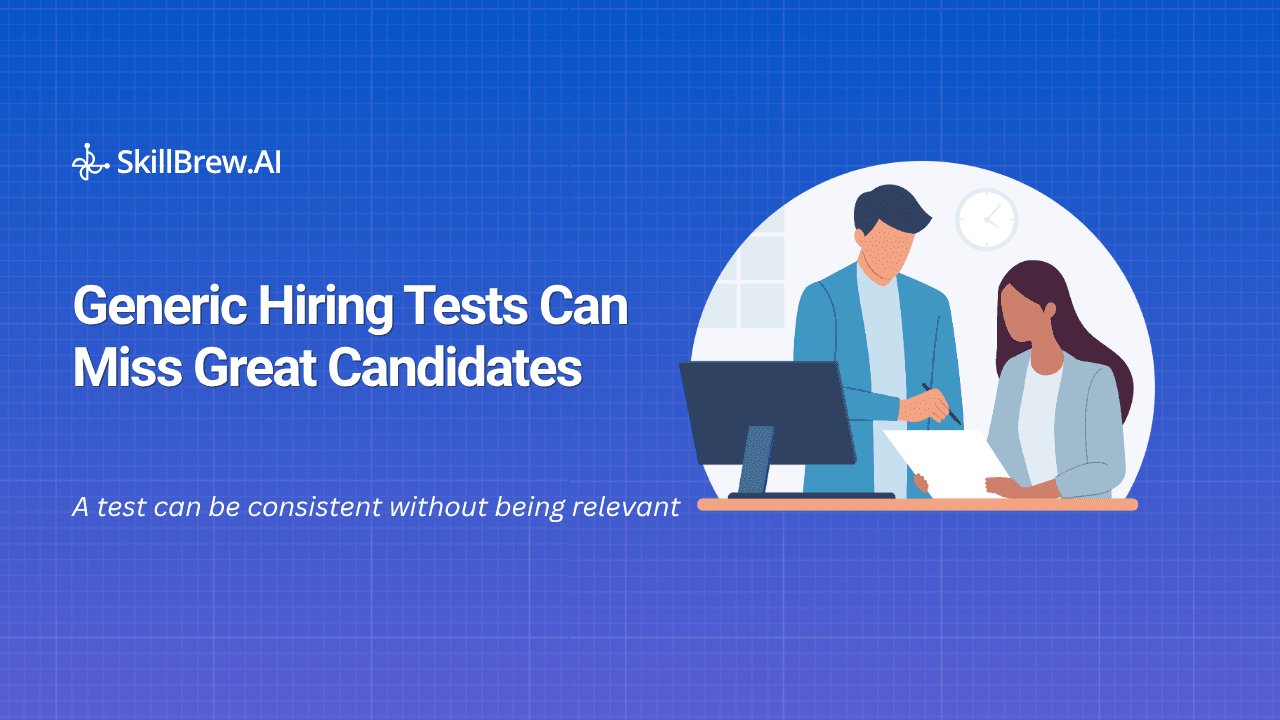
Why Generic Hiring Tests Can Miss Great Candidates
Hiring tests are supposed to make recruitment more objective. They give recruiters a structured way to compare candidates, measure skills, and narrow a large applicant pool. But there is a problem: a test can be consistent without being relevant. That distinction is the central issue. Standardized does not have to mean generic, and generic does not automatically mean ineffective. The problem is using an assessment that measures competencies unrelated to the job. When the same assessment is us

Hiring tests are supposed to make recruitment more objective. They give recruiters a structured way to compare candidates, measure skills, and narrow a large applicant pool.
But there is a problem: a test can be consistent without being relevant.
That distinction is the central issue. Standardized does not have to mean generic, and generic does not automatically mean ineffective. The problem is using an assessment that measures competencies unrelated to the job.
When the same assessment is used for every role, it may measure abilities that have little connection to the work a candidate will actually perform. A strong sales candidate may struggle with abstract reasoning questions. A capable developer may lose points on technologies unrelated to the role. A customer support candidate may be evaluated on general knowledge instead of communication, judgment, and problem-solving.
The problem is not necessarily that the assessment is poorly designed. It may simply be poorly matched to the hiring decision.
The answer is not to stop using hiring tests. It is to make them more job-relevant while preserving the consistency that makes structured assessment useful.
Key Takeaways
- Hiring tests are most useful when they measure competencies that matter for the specific role.
- Standardized does not have to mean generic.
- A high score on a broad assessment does not automatically mean strong job fit.
- Role-specific assessments can provide more useful evidence than one-size-fits-all tests.
- Work samples, structured interviews, and job-relevant scenarios can reveal skills that generic tests miss.
- Job relevance is an important starting point, but it should not be confused with proof that an assessment predicts future job performance.
- Assessment results should support hiring decisions, not replace human judgment.
Table of Contents
- What Are Hiring Tests?: Understand what assessments are designed to measure and why job relevance matters.
- Why Generic Hiring Tests Can Miss Qualified Candidates?: Explore how poorly matched assessments can overlook capable applicants.
- Standardized Does Not Have to Mean Generic: Learn why consistency and relevance can work together.
- What Makes a Hiring Test Job-Relevant?: See how responsibilities, competencies, assessment methods, and scoring criteria connect.
- Generic vs. Role-Specific Assessments: Compare the strengths and limitations of both approaches.
- Examples of Role-Specific Hiring Tests: See how assessments can reflect the work candidates will actually perform.
- How to Build More Relevant Hiring Tests: Follow a practical framework for creating job-relevant assessments.
- How AI Can Make Assessments More Role-Specific: Understand where AI can accelerate assessment creation.
- A Practical Checklist for Recruiters: Review the essential questions before sending an assessment.
- FAQs: Get quick answers to common assessment questions.
- Conclusion: See why relevance matters more than simply ranking candidates.
What Are Hiring Tests?
Hiring tests are assessments used to evaluate candidates before or during the selection process. Depending on the role, they can measure technical knowledge, cognitive ability, communication, judgment, problem-solving, personality-related traits, or practical skills.
They can be valuable because they give recruiters additional evidence beyond resumes and interviews. The U.S. Office of Personnel Management (OPM), for example, recognizes multiple assessment methods, including work samples, structured interviews, job-knowledge tests, cognitive ability assessments, and situational judgment tests.
OPM recommends basing assessment strategies on job analysis, linking assessments to job-related competencies, and considering evidence of validity when selecting assessment methods.
That distinction matters.
A hiring test is not automatically useful just because it produces a score. The real question is:
What does that score tell you about the candidate's ability to perform this particular job?
Job relevance is an important starting point, but it should not be confused with proof that an assessment predicts future job performance. Validity concerns the relationship between assessment performance and job performance, so recruiters should evaluate both what a test appears to measure and whether its results are useful for the hiring decision.
Why Generic Hiring Tests Can Miss Qualified Candidates
The biggest weakness of generic hiring tests is not that they are standardized. It is that they may measure broad abilities instead of the competencies required for a specific position.
Imagine a company hiring three people:
- A backend engineer who needs strong debugging and API skills
- A sales development representative who needs prospecting, communication, and objection handling
- A customer support specialist who needs empathy, product knowledge, and problem-solving
Giving all three candidates the same assessment creates an obvious mismatch.
The test may be standardized, but the jobs are not.
1. They Measure the Wrong Skills
A candidate can perform poorly on an assessment because it tests knowledge they will never need in the role.
For example, a frontend developer may be evaluated heavily on backend concepts. A recruiter may then interpret the score as evidence of weak technical ability, even though the candidate is highly capable in the area the job actually requires.
This is a measurement problem, not necessarily a candidate problem.
2. They Can Reward Test Familiarity
Candidates who have more experience with standardized assessment formats may be more comfortable with time limits, question structures, and testing strategies.
Another candidate may have equally strong job skills but less experience with those formats.
That familiarity can influence performance alongside the underlying competency being assessed. It does not mean the assessment is useless, but it is one reason recruiters should avoid treating a single score as a complete picture of capability.
3. They Flatten Different Types of Talent
People can be strong in different ways.
One candidate may excel at analytical reasoning. Another may be excellent at customer communication. A third may be exceptionally good at translating ambiguous requirements into practical solutions.
A single generic score can hide these differences.
Recruiters should be cautious about treating candidates as one-dimensional numbers when the job itself requires a combination of competencies.
4. They Create False Confidence
A standardized score can look objective because it is numerical.
But numerical does not automatically mean meaningful.
A score can be reliable and still be the wrong measure for the hiring decision. If an assessment consistently measures something that has little relationship to the role, its consistency does not make the result useful.
OPM explains that validity refers to the relationship between assessment performance and job performance. It also recommends using an up-to-date job analysis and considering validity evidence when selecting assessment methods.
In other words, the question is not simply whether candidates can be ranked. It is whether the ranking provides useful information about the work they will actually do.
Standardized Does Not Have to Mean Generic
Standardization is valuable in hiring because it can improve consistency. Candidates can receive comparable instructions, time limits, scoring rules, and evaluation criteria.
But standardization does not require every role to use identical questions.
A company can standardize its assessment process while tailoring the content to the job. For example, every candidate might complete an assessment with the same structure:
- A practical task
- A scenario-based question
- A structured response
- A predefined scoring rubric
The tasks themselves can differ by role.
A software engineer might complete a debugging exercise. A sales candidate might respond to a customer objection. A data analyst might interpret a dataset. The process remains consistent, but the evidence is relevant.
This is the stronger principle:
Standardize the process. Tailor the evidence.
What Makes a Hiring Test Job-Relevant?
Better hiring tests start with the job—not with a question bank.
Before creating an assessment, recruiters and hiring managers should identify the competencies that actually matter.
A useful framework is:
Job requirement → Competency → Appropriate assessment method → Assessment item → Scoring criteria
For example:
Job responsibility: Analyze campaign performance.
Required competencies: Data interpretation, analytical reasoning, attention to detail, and business communication.
Assessment method: A data exercise followed by a written explanation.
Assessment item: Give the candidate a small campaign dataset and ask them to identify trends, explain an anomaly, and recommend next steps.
Scoring criteria: Accuracy, reasoning, quality of recommendations, and ability to explain conclusions clearly.
This is much more informative than asking the candidate 20 unrelated multiple-choice questions.
Match Competencies to Assessment Methods
The best assessment method depends on the competency being measured.
| Competency | Better assessment method |
| Coding | Coding exercise or work sample |
| Communication | Structured interview or voice response |
| Customer judgment | Situational judgment scenario |
| Data analysis | Data exercise |
| SQL | SQL task |
| Sales objection handling | Role-play |
| Written communication | Writing sample |
OPM's assessment guidance covers multiple approaches, including work samples, structured interviews, cognitive ability tests, job-knowledge tests, and situational judgment tests. The appropriate method depends on the job analysis and the competency being evaluated.
Generic vs. Role-Specific Assessments
The difference can be summarized simply:
| Generic Assessment | Role-Specific Assessment |
| Same questions for many roles | Questions mapped to the target role |
| Measures broad abilities | Measures relevant competencies |
| Easier to reuse | More aligned with job requirements |
| Can produce simple rankings | Provides more actionable evidence |
| May miss specialized skills | Can surface role-specific strengths and gaps |
| Focuses heavily on score | Focuses on score plus evidence |
This does not mean generic assessments are always bad.
A cognitive ability assessment, for example, may be useful when the construct being measured is genuinely relevant to the job. A broad assessment can also be appropriate when candidates across several roles need the same underlying capability.
The issue is using a test simply because it is available rather than because it answers an important hiring question.
The strongest assessment strategy may also combine methods. OPM notes that combining different selection tools can provide incremental validity when the tools measure different job-related factors.
Examples of Role-Specific Hiring Tests
A practical example makes the difference clearer.
Example: Hiring a Data Analyst
Suppose a company needs a data analyst who will work with business datasets, write SQL queries, identify anomalies, and explain findings to non-technical stakeholders.
Generic assessment
The candidate receives:
- 30 quantitative reasoning questions
- Abstract numerical puzzles
- General aptitude questions
- No SQL
- No data interpretation
- No written explanation of findings
This assessment may provide information about general quantitative reasoning. But it does not directly show whether the candidate can perform several central responsibilities of the role.
Role-specific assessment
The candidate receives:
- A small business dataset
- A request to identify an anomaly
- A SQL task
- A prompt asking them to explain the finding to a non-technical stakeholder
- A recommendation question asking what action the business should take
Both assessments produce a score. But only the second gives the hiring team direct evidence of several competencies the role actually requires.
The same principle applies across roles:
- A developer can debug a realistic code sample.
- A sales candidate can respond to a prospect's objection.
- A support candidate can write a response to a frustrated customer.
- A recruiter can evaluate a sample candidate profile and explain a sourcing strategy.
- A product manager can prioritize competing requests and explain the trade-offs.
These tasks do not need to replicate the entire job. They should provide focused evidence about important competencies.
How to Design a Job-Relevant Hiring Test
Here is a practical process recruiters can follow.
Step 1: Identify Responsibilities
Start with the actual work.
Review the job description with the hiring manager and identify the tasks the person will perform regularly. Avoid relying only on broad labels such as “strategic,” “analytical,” or “technical.”
Ask:
- What will this person do during a typical week?
- Which tasks are most important?
- Which tasks are difficult to learn after hiring?
- What outcomes will define success?
Step 2: Define Required Competencies
Translate responsibilities into observable competencies.
For example:
- Debugging a production issue requires technical reasoning and attention to detail.
- Handling a customer escalation requires judgment, empathy, and communication.
- Analyzing campaign performance requires data interpretation and business reasoning.
Separate must-have competencies from nice-to-have skills. If SQL is essential for a data analyst role, it should carry more assessment weight than a skill that will only occasionally be used.
Step 3: Select the Appropriate Assessment Method
Do not assume every competency should be measured with a traditional test.
Choose the method that best reflects the skill:
- Work sample for practical performance
- Structured interview for communication or behavioral competencies
- Situational judgment test for decision-making
- Job-knowledge test for essential technical knowledge
- Cognitive ability assessment when the construct is relevant
- Role-play for sales, support, or stakeholder interaction
- Writing sample for written communication
Step 4: Create Role-Specific Tasks or Questions
Every item should have a clear purpose.
Ask:
- What skill does this question measure?
- Why does this skill matter for the role?
- What would a strong answer look like?
- Is the difficulty appropriate for the level?
- Does the task resemble an important part of the work?
If you cannot answer these questions, the item may not belong in the assessment.
Step 5: Define Scoring Criteria Before Candidates Take the Test
Create clear scoring rules and benchmarks.
For a data exercise, scoring might include accuracy, reasoning, interpretation, and communication. For a role-play, it might include listening, clarity, judgment, and response quality.
Structured interviews use a similar principle: candidates are evaluated against predefined questions and rating standards tied to job-related competencies.
Step 6: Validate Against Hiring Outcomes
An assessment should not be treated as finished forever.
Track whether assessment results relate to later performance, retention, training progress, or other appropriate outcomes. If certain questions do not provide useful differentiation, revise them.
This creates a feedback loop between assessment results and real hiring outcomes.
How AI Can Make Assessments More Role-Specific
AI can make the assessment-building process faster, but speed should not replace good assessment design.
AI can help operationalize this process at scale. Instead of manually creating a new assessment for every role, recruiters can use AI to analyze a job description, identify relevant competencies, and generate assessment questions or scenarios aligned with those requirements.
This can help recruiters move from generic question banks toward assessments tailored to the role.
This is where platforms such as SkillBrew.AI can help. SkillBrew.AI's assessment builder can use job requirements to create role-specific assessments across technical, behavioral, and cognitive areas, helping recruiters connect job requirements with assessment content and structured candidate insights.
The important point is not simply that AI can generate more questions.
It is that AI can help recruiters connect:
job requirements → competencies → assessment methods → questions or tasks → evaluation criteria
Recruiters should still review generated assessments to ensure that questions are relevant, appropriately difficult, inclusive, and aligned with the actual role. Recruiters should still review AI-generated assessments and results in the context of the role, assessment design, and broader hiring evidence.
Build assessments around the actual requirements of the role with SkillBrew.AI.
Build a Role-Specific Assessment →
A Practical Checklist for Recruiters
Before sending hiring tests to candidates, ask:
- Does the assessment reflect the actual job?
- Are the most important competencies represented?
- Does each question measure something relevant?
- Has the appropriate assessment method been selected for each competency?
- Are practical skills tested where appropriate?
- Are scoring criteria defined in advance?
- Is the assessment measuring job-related ability rather than test familiarity?
- Are candidates evaluated consistently?
- Can recruiters see evidence behind the score?
- Is the assessment being used as evidence rather than as an automatic decision?
- Are assessment results combined with other relevant selection evidence?
- Are outcomes reviewed after hiring?
If several answers are “no,” the assessment probably needs to be redesigned.
FAQs
Q1. Are hiring tests effective?
They can be effective when they are reliable, job-related, and supported by appropriate validity evidence. A test should provide useful information about competencies that matter for the position rather than simply produce a ranking.
Q2. Should Every Candidate Take the Same Hiring Test?
Candidates should generally be evaluated consistently, but consistency does not require every role to use identical content. Different roles can use standardized processes while assessing different job-relevant competencies.
Q3. What Is the Difference Between a Generic and Role-Specific Assessment?
A generic assessment measures broad abilities or uses the same content across multiple roles. A role-specific assessment maps its questions or tasks to the responsibilities and competencies of a particular position. Generic assessments can be useful when the measured construct is relevant across roles, while role-specific assessments usually provide more direct evidence of job-related capability.
Q4. Are Generic Hiring Tests Always Bad?
No. A generic assessment can be useful when the ability being measured is genuinely relevant across the roles being assessed. The problem occurs when a generic test is used as a substitute for understanding what a particular job requires.
Q5. How Can Recruiters Make Hiring Tests More Relevant?
Start with a job analysis, identify critical competencies, select appropriate assessment methods, map those competencies to assessment questions or work samples, define scoring criteria, and review results against actual job outcomes.
Q6. Can AI Replace Recruiters When Evaluating Assessments?
AI can automate question generation, scoring, summaries, and parts of the evaluation workflow, but recruiters and hiring managers should remain responsible for interpreting results in context and making the final selection decision.
Conclusion
The goal of hiring tests is not to find candidates who are best at taking tests.
It is to gather useful evidence about who can succeed in the job.
When assessments are poorly aligned with a role, they can overlook practical ability, communication, judgment, and specialized competencies. A candidate who looks average on a broad assessment may demonstrate strong potential when evaluated on tasks that reflect the actual work.
The better approach is not to abandon structured assessment. It is to make it more relevant.
Start with the job. Identify the competencies. Select the right assessment methods. Build questions and tasks around those competencies. Define clear scoring criteria. Then use the results alongside interviews, work samples, experience, and other relevant evidence.
For teams that want to put this approach into practice, SkillBrew.AI offers an assessment builder that helps create role-specific assessments from job requirements, covering technical, behavioral, and cognitive competencies. It also helps recruiters evaluate candidates consistently and review structured insights alongside other hiring evidence.
Explore SkillBrew.AI's Role-Specific Assessment Builder →
Good hiring tests do more than rank candidates.
They help recruiters ask a better question:
Can this candidate demonstrate the skills this job actually requires?
See AI-powered hiring in action
Discover how SkillBrew helps hiring teams cut time-to-hire by 60% with skill-validated assessments and AI-ranked shortlists.
Book a free demoNo commitment required · 30 minutes
Continue reading
View All Posts