AI Interview
AI Hiring Compliance: What Recruiters Need to Know About AI Interviews
AI can screen hundreds of candidates in the time it takes a recruiter to conduct a handful of interviews. But faster hiring creates another responsibility: knowing what happens to candidate data and how AI influences the decisions that follow. Is the AI hiring process compliant? That question matters because AI interviews can process significantly more candidate information than a traditional interview. Depending on the platform and configuration, that information may include interview respons

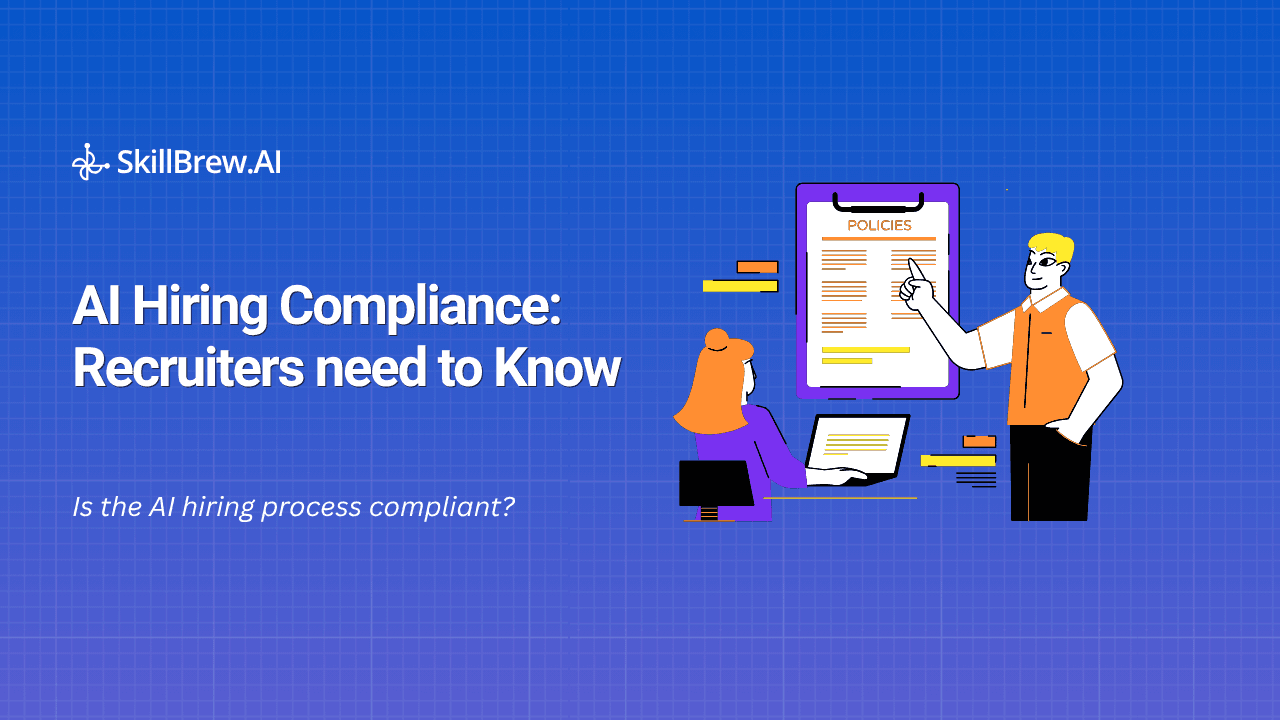
AI can screen hundreds of candidates in the time it takes a recruiter to conduct a handful of interviews. But faster hiring creates another responsibility: knowing what happens to candidate data and how AI influences the decisions that follow.
Is the AI hiring process compliant?
That question matters because AI interviews can process significantly more candidate information than a traditional interview. Depending on the platform and configuration, that information may include interview responses, transcripts, recordings, identity information, assessment results, technical performance, and integrity signals.
AI hiring compliance is therefore not simply about checking whether a software vendor has a privacy policy. It requires recruiters to understand what data an AI system collects, why it collects it, how that data is evaluated, who can access it, how long it is retained, and what role AI plays in the final hiring decision.
Regulatory requirements also vary by jurisdiction and continue to evolve. In the European Union, Certain AI systems used in employment, including systems intended to analyze and filter job applications or evaluate candidates, are classified as high-risk under Annex III of the EU AI Act. The application timeline for this category has changed since the Act was first passed, which is exactly the kind of shift recruiters need to track rather than assume.
For recruiters, the goal isn't to become lawyers or AI engineers. It is to build a hiring workflow where candidates understand how AI is being used, sensitive information is handled responsibly, and humans remain accountable for important employment decisions.
This guide explains the major areas recruiters should consider when building an AI-powered hiring process.
Table of Contents
- What Is AI Hiring Compliance?: Understand what compliance means when AI is involved in recruiting, screening, and interviewing.
- Why AI Hiring Compliance Matters: See why candidate data, automated evaluation, and employment decisions create additional responsibilities.
- What Candidate Data Can AI Interviews Collect?: Learn which types of information may be processed during an AI interview.
- AI Interview Privacy and Candidate Consent: Understand why transparency and meaningful consent matter when collecting interview data.
- AI Hiring Compliance vs. AI Interview Privacy: See how these two related terms differ and where they overlap.
- AI Hiring Compliance Across Different Regulations: Explore important considerations under frameworks such as the EU AI Act and India's DPDP framework.
- Automated Decision-Making and Candidate Rejection: Learn the difference between an AI recommendation and an automated hiring decision.
- Bias and Fairness in AI Hiring: Learn how recruiters can monitor AI systems for inconsistent or discriminatory outcomes.
- Human Oversight in AI Interviews: Understand why AI recommendations should not automatically become hiring decisions.
- How to Evaluate an AI Interview Vendor: Get practical questions to ask before choosing an AI hiring platform.
- AI Hiring Compliance Checklist: Use a practical checklist to review your organization's AI interview workflow.
- Common AI Hiring Compliance Mistakes: Avoid the recurring errors that undermine otherwise well-intentioned programs.
- Best Practices for Responsible AI Hiring: Build compliance into the workflow rather than bolting it on afterward.
- How SkillBrew.AI Supports Responsible AI Hiring: See how structured evaluation and integrity signals fit into a compliant workflow.
- Conclusion: Key takeaways for building a responsible AI-powered hiring process.
- FAQs: Quick answers to common recruiter questions about AI hiring compliance.
- Sources & Further Reading: Primary sources referenced in this guide.
What Is AI Hiring Compliance?
AI hiring compliance refers to the policies, processes, controls, and legal requirements organizations consider when using artificial intelligence in recruitment and employment decisions.
It can cover several parts of the hiring workflow:
- Resume screening
- Candidate ranking
- Interview question generation
- Automated interviews
- Candidate assessments
- Interview transcription
- Candidate scoring
- Proctoring and integrity monitoring
- Interview recommendations
- Candidate data storage
The important distinction is that compliance isn't a single checkbox.
An organization can have a secure AI platform and still have an inappropriate hiring process if candidates aren't properly informed about how their information is being used.
Likewise, a transparent process can still create problems if the AI system produces systematically unfair results or if recruiters allow automated recommendations to become unreviewed hiring decisions.
A good AI hiring compliance program therefore considers the entire workflow rather than focusing only on the technology.
Why AI Hiring Compliance Matters
Traditional interviews already involve personal information. AI can increase the amount, variety, and scale of information being processed.
Consider a typical AI interview.
A candidate may:
- Receive an interview invitation.
- Verify their identity.
- Answer questions through video or voice.
- Submit technical or behavioral responses.
- Generate a transcript.
- Receive automated competency scores.
- Trigger integrity or proctoring signals.
- Become part of a ranked candidate shortlist.
Each stage creates potential compliance considerations.
This is why AI hiring compliance needs to be considered before the system is introduced rather than after the first group of candidates has completed interviews.
It also helps protect the organization from another common problem: assuming that because a vendor provides an AI hiring tool, the vendor automatically takes responsibility for every compliance obligation.
The employer still needs to understand its own responsibilities, the vendor's role, and how the system is configured and used.
What Candidate Data Can AI Interviews Collect?
Before evaluating AI hiring compliance, recruiters should understand exactly what their interview platform processes.
Depending on the product, an AI interview may process:
Basic Candidate Information
This can include:
- Name
- Email address
- Phone number
- Resume information
- Job application details
Interview Content
This can include:
- Candidate answers
- Audio recordings
- Video recordings
- Transcripts
- Interview timestamps
- Questions presented to the candidate
Assessment Information
This may include:
- Technical assessment results
- Competency scores
- Behavioral evaluations
- Role-fit scores
- Overall interview scores
Integrity Information
If proctoring is enabled, the platform may also process signals relating to:
- Identity verification
- Screen activity
- Multiple-person detection
- Background audio
- Other activity indicators flagged for review
The exact information depends on the platform and configuration, so recruiters should ask vendors for a clear data inventory rather than assuming every AI interview product collects the same information.
Just because a system can collect a signal doesn't mean a recruiter should collect it. If a data point isn't tied to a specific, justified evaluation purpose, it's worth asking why it's being gathered at all. This principle, generally known as data minimization, is one of the most practical ways recruiters can reduce unnecessary data processing and strengthen their overall privacy and compliance posture.
This is also where AI interview privacy becomes particularly important.
Candidates should be able to understand what information is being collected, why it is being collected, and how it will be used.
AI Interview Privacy and Candidate Consent
Privacy should be treated as a core part of AI hiring compliance, not as an afterthought.
A candidate should not have to guess whether an interview is being recorded, transcribed, analyzed, or scored by AI.
The appropriate notice and consent requirements depend on the applicable law and processing context. For example, India's Digital Personal Data Protection Act, 2023 establishes requirements around notice and consent, including that consent, where used as the basis for processing, be free, specific, informed, unconditional, and unambiguous.
India's Digital Personal Data Protection Rules, 2025 were notified by the Ministry of Electronics and Information Technology on November 14, 2025, and they set out how notices should be worded: understandably, in clear language, and covering the personal data involved and the purpose of processing. Compliance under the Rules is staggered across several phases, so organizations should confirm which specific provisions currently apply to their processing activities rather than assuming the entire framework is already in force.
For recruiters, the practical lesson is simple:
Don't hide AI usage inside a long privacy policy.
Candidates should receive understandable information about the relevant processing.
For example, an interview notice might explain:
- That AI is being used during the interview
- What information is collected
- Whether the interview is recorded
- Whether responses are transcribed
- What the AI evaluates
- Why the information is needed
- Who may access the results
- How long information is retained
- How candidates can raise questions or exercise applicable rights
The exact notice should be reviewed against the laws applicable to the employer and candidate.
AI Hiring Compliance vs. AI Interview Privacy
These two terms are related but not identical, and mixing them up can lead to gaps in either direction.
AI interview privacy focuses specifically on how candidate information is collected, processed, stored, accessed, and shared during an interview.
AI hiring compliance is broader. It includes privacy, but also security, fairness, transparency, human oversight, automated decision-making, documentation, and the applicable employment or AI-specific regulations that govern the hiring process as a whole.
In practice, a recruiter can get privacy right, clear notices, defined retention, proper consent, and still fall short on compliance if there's no human reviewing AI-generated recommendations before a candidate is rejected. Treating the two as the same thing is one of the more common gaps in otherwise well-intentioned programs.
AI Hiring Compliance Across Different Regulations
There is no single worldwide rulebook for AI recruiting.
Companies hiring internationally may need to consider multiple legal frameworks simultaneously.
European Union: EU AI Act
The EU AI Act takes a risk-based approach to AI regulation. AI systems used for certain employment-related purposes, including systems that analyze and filter job applications or evaluate candidates, sit within the Act's high-risk category under Annex III.
Important: The compliance timeline for this category has moved. Under the original AI Act text, high-risk obligations for these systems were due to apply from August 2, 2026. Following the "Digital Omnibus" amendment package, the European Commission has confirmed that high-risk obligations for standalone Annex III systems, including recruitment and employment-related AI, will apply from December 2, 2027. This gives employers and vendors more time to prepare, but it does not remove the obligations themselves, and organizations should still prepare in advance rather than wait for the new date to approach. Recruiters should monitor official Commission guidance for further updates, since implementation details can continue to shift.
For applicable high-risk systems, the framework's requirements include:
- Risk assessment and mitigation
- Appropriate data governance
- Logging and traceability
- Documentation
- Human oversight
- Accuracy
- Robustness
- Cybersecurity
Recruiters using AI for hiring in the EU should determine how their specific system and use case are classified rather than assuming every AI tool carries identical obligations, and rather than assuming the extended deadline means the requirements can be ignored in the meantime.
India: DPDP Framework
For organizations operating in India, candidate information may fall within the scope of India's digital personal data framework.
The DPDP Act establishes requirements concerning notice, consent, processing, and data principal rights. The DPDP Rules, 2025, notified on November 14, 2025, add operational detail including requirements around notices, consent-related information, and certain data principal requests.
The framework is subject to phased commencement, with different provisions taking effect immediately, after one year, or after eighteen months from the Rules' notification date.
Other Jurisdictions
Recruiters may also need to consider:
- Data protection laws
- Employment discrimination laws
- Automated decision-making requirements
- Biometric privacy rules
- Recording and consent laws
- Sector-specific regulations
- Local AI legislation
This makes AI hiring compliance a jurisdiction-specific exercise.
A platform that works for one company's hiring workflow may require additional controls for another company's workforce, candidate locations, or regulatory environment.
Automated Decision-Making and Candidate Rejection
One distinction matters more than almost any other in this space: an AI recommendation is not the same thing as an automated decision.
An AI recommendation is generally an output intended for human review. An automated decision occurs when the system's output determines an outcome with little or no meaningful human intervention, depending on the applicable legal framework.
Recruiters should think through:
- Does a human review every AI-influenced rejection, or only a sample?
A workflow where AI scores feed directly into an auto-reject rule, with no meaningful human review, may amount to automated decision-making depending on the applicable legal framework and how the system is actually used. - Can the recruiter explain why a candidate was screened out?
If the answer is "the AI scored them low" with no further detail, that's a gap worth closing. - Are candidates notified when AI played a substantial role in a decision, where applicable law requires it?
Notification and explainability requirements differ by jurisdiction, so this should be reviewed against the rules that apply to each hiring location.
The safest default is to treat AI outputs as decision-support rather than a decision itself, particularly at the rejection stage, and to be able to point to the human step that reviewed the outcome.
Bias and Fairness in AI Hiring
Privacy is only one part of responsible AI hiring.
Recruiters also need to ask:
Does the system evaluate candidates consistently?
An AI model can produce apparently objective scores while still generating unfair outcomes if its design, training data, evaluation criteria, or implementation introduces systematic bias.
For applicable high-risk AI systems under the EU AI Act, requirements include measures intended to address discriminatory outcomes, representative datasets, monitoring, and traceability.
Recruiters should therefore monitor whether AI-generated evaluations differ unexpectedly across candidate groups.
Useful practices include:
- Defining job-related evaluation criteria
- Testing the system before deployment
- Monitoring outcomes over time
- Reviewing unusual scoring patterns
- Auditing assessment criteria
- Keeping humans involved in important decisions
- Reassessing the system when the role or evaluation methodology changes
The objective isn't to assume that AI is unbiased.
The objective is to measure, monitor, and manage the risk of bias.
Human Oversight in AI Interviews
One of the most important principles of AI hiring compliance is keeping humans accountable for consequential employment decisions.
AI can identify patterns.
AI can organize candidate information.
AI can produce structured interview reports.
But recruiters and hiring managers should understand what those outputs mean before using them to make decisions.
A strong workflow looks like this: AI evaluates → Recruiter reviews → Hiring manager considers context → Human makes the decision
A weak workflow looks like this: AI scores candidate → Candidate automatically rejected
Human oversight is also explicitly part of the EU AI Act's requirements for applicable high-risk systems. The Commission states that deployers of such systems must assign human oversight to people who are sufficiently equipped and enabled to exercise it.
Human oversight doesn't mean ignoring AI.
It means ensuring that AI remains a decision-support layer rather than an unquestioned decision-maker.
How to Evaluate an AI Interview Vendor
Before purchasing an AI hiring platform, recruiters should ask more than "how accurate is your AI?"
The questions below are the ones that actually support AI hiring compliance and AI interview privacy, and they're worth putting directly to any vendor during evaluation.
| Vendor question | Why it matters |
| What candidate data do you collect? | Establishes a baseline for privacy review and data minimization |
| Where is candidate data stored? | Determines hosting location, data residency, and cross-border transfer exposure |
| Is candidate data used to train AI models? | Flags whether interview data has a secondary use beyond the hiring decision |
| How long is data retained, and is retention configurable? | Supports your organization's own retention and deletion policy |
| How is the AI evaluated for bias? | Shows whether fairness testing happens before and after deployment |
| Can recruiters override AI recommendations? | Confirms the platform supports human oversight rather than automated rejection |
| What security controls are in place? | Covers encryption, access controls, authentication, and audit logs |
| Who are your subprocessors? | Reveals which third parties may also touch candidate data |
| What documentation is available? | Supports your own compliance and audit trail |
A vendor that can answer these clearly and specifically, rather than pointing you to a generic privacy page, is a meaningfully better sign than a claimed accuracy percentage.
AI Hiring Compliance Checklist
Before launching AI interviews, recruiters can use this checklist:
- Identify every AI system used in the hiring workflow.
- Document what candidate data each system processes.
- Define why each category of data is needed.
- Provide candidates with appropriate privacy and AI-use information.
- Obtain consent where consent is the applicable legal basis.
- Establish appropriate data retention periods.
- Review vendor sub-processors and data-transfer arrangements.
- Confirm appropriate security controls.
- Understand whether candidate data is used for model training.
- Define who can access interview reports.
- Establish human review procedures for AI-influenced decisions.
- Test and monitor for potentially unfair outcomes.
- Document the organization's AI hiring process.
- Review applicable regulations for every hiring jurisdiction.
- Reassess compliance when the AI system or hiring workflow changes.
This checklist isn't a substitute for legal advice, but it gives recruiting teams a practical starting point for building a responsible process.
Common AI Hiring Compliance Mistakes
Even organizations with good intentions can make avoidable mistakes.
Treating Compliance as the Vendor's Responsibility
A vendor's compliance documentation is useful, but the employer still needs to understand how the technology is deployed.
Collecting More Data Than Necessary
If a particular data point isn't needed for the hiring purpose, consider whether it should be collected at all.
Keeping Candidate Data Indefinitely
Retention should have a defined purpose and follow applicable legal and organizational requirements.
Hiding AI Usage From Candidates
Transparency should be part of the candidate experience.
Treating AI Scores as Objective Truth
An AI-generated score is an output of a system, not an unquestionable measurement of candidate quality. This applies just as much to proctoring signals: things like multiple-person detection or unexpected background audio are indicators worth a human look, not proof of misconduct on their own.
Ignoring Regional Requirements
A global recruitment team may need different controls depending on where candidates are located and where the employer operates.
Avoiding these mistakes is a central part of building a program that holds up over time, not just at launch.
Best Practices for Responsible AI Hiring
The strongest approach to AI hiring compliance is proactive rather than reactive.
Start by mapping your entire hiring workflow.
Identify:
What data enters the system → What AI does with it → What output it produces → Who sees the output → What decision is made
Then establish controls around each stage.
Recruiters should also:
- Use job-related evaluation criteria. Questions and scoring should reflect actual role requirements.
- Keep candidates informed. Explain relevant AI processing in clear language.
- Minimize unnecessary data collection. Don't collect information simply because the technology can.
- Control access. Candidate recordings, transcripts, and reports should only be available to authorized users.
- Monitor performance. Review whether the system behaves consistently after deployment, not only during initial testing.
- Maintain human oversight. AI should support important hiring decisions rather than eliminate accountability, especially at the rejection stage.
- Review vendors regularly. Security, privacy, regulations, and AI capabilities change over time, as the recent shifts in both the EU AI Act timeline and India's DPDP framework show.
These practices fold compliance into the hiring workflow itself rather than treating it as a separate legal exercise bolted on at the end.
How SkillBrew.AI Supports Responsible AI Hiring
SkillBrew.AI helps recruiting teams structure candidate evaluation while keeping humans in the review loop, rather than replacing that judgment outright.
AI Interviews use an adaptive, resume-aware format instead of a static one-way recording, giving hiring teams a fuller picture of a candidate before anyone makes a call. Technical Assessments generate role-specific questions directly from a job description, which keeps evaluation criteria tied to the actual role rather than a generic template. BrewShield flags integrity signals for recruiter review during interviews and assessments, in line with the principle that these signals should support a human decision rather than trigger one automatically. And HireFlow keeps candidate data, scoring, and communication inside one auditable workflow instead of scattered across spreadsheets and inboxes.
None of this replaces your organization's own legal, privacy, and security review. SkillBrew.AI is a tool for building a more structured, better-documented hiring process, not a substitute for evaluating your specific regulatory obligations. If you want to see how the workflow fits your hiring volume and jurisdictions, you can book a demo.
Conclusion
AI can make recruitment faster and more consistent, but speed shouldn't come at the expense of candidate rights, transparency, security, or accountability.
AI hiring compliance starts with understanding what the technology does and continues through every stage of the candidate journey: data collection, interviewing, analysis, reporting, and decision-making.
For recruiters, the most important questions are straightforward:
What data are we collecting? Why are we collecting it? How is AI using it? Can candidates understand what's happening? Are we monitoring for unfair outcomes? And does a human remain accountable for the final decision?
Answering those questions before deploying an AI interview platform creates a stronger foundation for responsible hiring, and revisiting them as regulations like the EU AI Act and India's DPDP framework continue to evolve keeps that foundation current.
FAQs
Q1. What is AI hiring compliance?
AI hiring compliance is the process of ensuring that AI used in recruitment is deployed in accordance with applicable privacy, employment, AI, security, and data-protection requirements.
Q2. Why is AI interview privacy important?
AI interviews can process personal information such as candidate responses, recordings, transcripts, assessment results, and other evaluation data. AI interview privacy helps ensure candidates understand how relevant information is collected and used.
Q3. Does AI hiring compliance apply to every company?
The specific requirements depend on factors such as the company's location, candidate location, industry, AI use case, type of data processed, and applicable laws. Companies should assess their own circumstances rather than assuming one compliance framework applies universally.
Q4. Should candidates be told that an interview uses AI?
Recruiters should provide appropriate transparency about AI use and data processing, subject to the applicable legal requirements. In some regulatory contexts, specific transparency obligations may apply.
Q5. Can AI make the final hiring decision?
Organizations should carefully assess the legal and operational implications of automated decision-making. For applicable high-risk AI systems under the EU AI Act, human oversight is an explicit requirement.
Q6. Does using an AI interview automatically make a hiring process non-compliant?
No. The compliance implications depend on the AI system, the data processed, the hiring use case, the jurisdiction, and how the system is deployed and reviewed.
Q7. Can AI interview recordings be stored indefinitely?
Not simply because they're useful to keep around. Organizations should set retention periods based on applicable legal requirements, legitimate business needs, and their own data governance policies.
Q8. How can recruiters evaluate an AI interview vendor?
Ask about data collection, retention, security, sub-processors, model training, bias testing, documentation, human oversight, and the vendor's ability to support your organization's applicable compliance requirements.
Q9. What is the most important part of AI hiring compliance?
There isn't one universal requirement. A strong program combines data protection, transparency, security, fairness, appropriate human oversight, documentation, and ongoing monitoring based on the organization's specific use case and jurisdictions.
Q10. How should recruiters handle AI-generated interview scores?
AI-generated scores should be treated as decision-support rather than unquestionable measures of candidate quality. Recruiters should understand what the score represents, review relevant candidate evidence, and apply appropriate human judgment before making consequential hiring decisions.
Disclaimer: This article provides general information about AI hiring compliance and is not legal advice. Requirements vary based on jurisdiction, hiring use case, candidate location, data processing activities, and other circumstances. Organizations should consult qualified legal, privacy, or compliance professionals regarding their specific obligations.
See AI-powered hiring in action
Discover how SkillBrew helps hiring teams cut time-to-hire by 60% with skill-validated assessments and AI-ranked shortlists.
Book a free demoNo commitment required · 30 minutes
Continue reading
View All Posts