BrewVoice
AI Voice Screening vs Phone Screening: Which Is Better for High-Volume Hiring?
When hiring volume increases, the first bottleneck usually isn't finding candidates. It's screening them. A recruiter may spend 10 to 20 minutes on every initial phone screen. Multiply that across hundreds or thousands of applicants, and the screening stage can quickly consume days of recruiter time. Manual phone screening becomes increasingly difficult once a team needs to process hundreds or thousands of applicants for a single role, and that difficulty compounds during campus drives, seasona

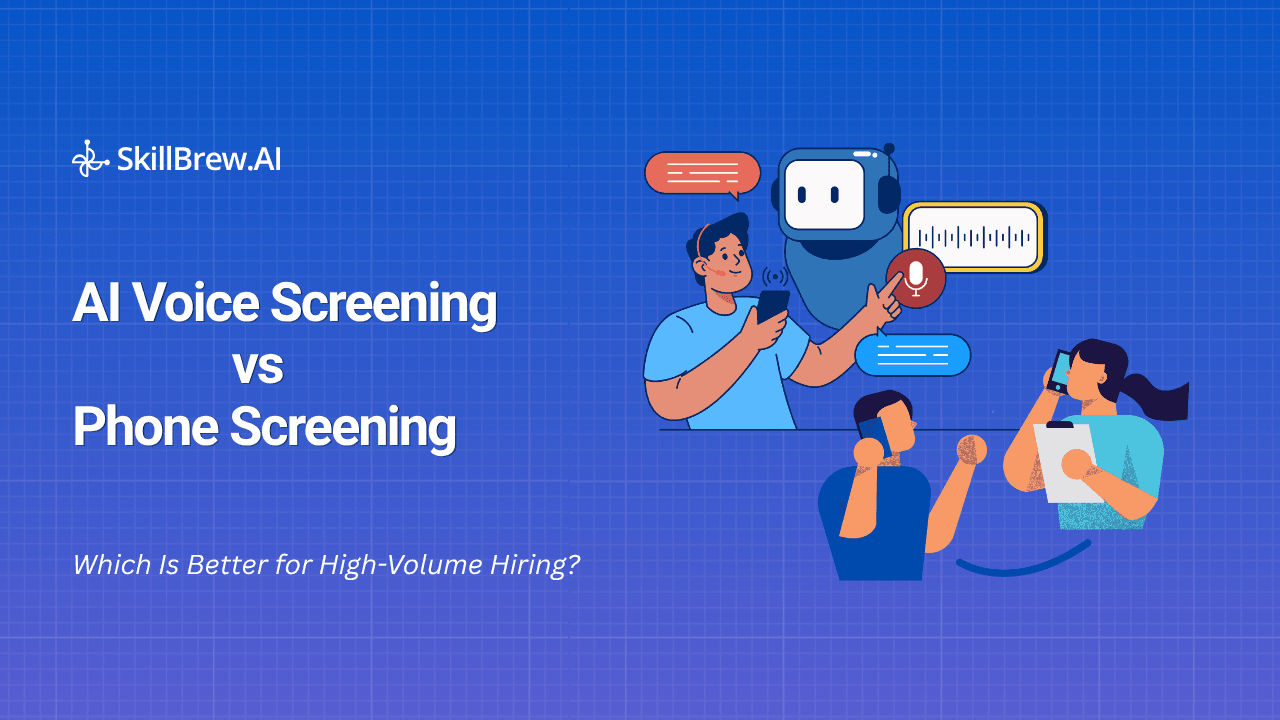
When hiring volume increases, the first bottleneck usually isn't finding candidates. It's screening them.
A recruiter may spend 10 to 20 minutes on every initial phone screen. Multiply that across hundreds or thousands of applicants, and the screening stage can quickly consume days of recruiter time. Manual phone screening becomes increasingly difficult once a team needs to process hundreds or thousands of applicants for a single role, and that difficulty compounds during campus drives, seasonal hiring, or multi-client staffing campaigns where volume spikes without warning.
A Voice AI screening tool changes the economics of that first-stage conversation. It can automate the initial call, ask structured questions, assess responses, and hand recruiters a shortlist worth reviewing, while keeping human judgment in the loop for later-stage decisions. Traditional phone screening, on the other hand, puts a recruiter directly into every conversation, one candidate at a time.
For high-volume hiring teams, the real question isn't whether AI is "better." It's which parts of the screening funnel should be automated, and which still need a human voice.
Table of Contents
- What Is AI Voice Screening?: how the conversation works
- What Is Traditional Phone Screening?: the recruiter-led baseline
- Key Differences at a Glance: side-by-side comparison table
- Speed and Screening Capacity: hours saved at volume
- Consistency of Candidate Evaluation: standardized vs. variable
- Candidate Experience: flexibility vs. personal touch
- Scalability for High-Volume Hiring: campus, staffing, seasonal drives
- Cost and Recruiter Productivity: where recruiter time actually goes
- The Hybrid Model: AI Screening + Human Recruiter: the recommended setup
- Where Traditional Phone Screening Still Makes Sense: senior and low-volume roles
- How a Voice AI Screening Tool Works: the six-step process
- How SkillBrew.AI Uses Voice AI for Recruitment: BrewVoice in practice
- Frequently Asked Questions: quick answers
- Final Takeaway: the short version
What Is AI Voice Screening?
AI voice screening is an automated recruitment process where an AI system holds a voice conversation with a candidate on behalf of the hiring team.
A Voice AI screening tool can conduct an initial screening conversation without requiring a recruiter to call every applicant individually. The system asks questions, understands spoken responses, checks them against predefined criteria, and organizes the results for recruiter review.
For example, a company hiring customer support executives may want to check communication ability, relevant experience, language proficiency, availability, and willingness to work specific shifts. Instead of a recruiter manually verifying each requirement on a call, a Voice AI screening tool can build these criteria directly into the conversation.
Modern voice screening software also goes beyond a fixed script. During an AI voice interview, the system can follow up on what a candidate actually says rather than reading down a checklist, which makes the exchange feel closer to a real conversation than an automated phone tree.
The real difference, then, isn't whether candidates should have a conversation. It's who handles the first conversation.
What Is Traditional Phone Screening?
Traditional phone screening is one of the most common methods recruiters use to qualify candidates before an interview.
A recruiter typically calls a candidate and asks about:
- Work experience
- Relevant skills
- Salary expectations
- Notice period
- Location
- Availability
- Communication
- Role-specific requirements
The recruiter takes notes and decides whether the candidate should move forward.
For small hiring volumes, this works well. Recruiters can build rapport, clarify answers, explain the role, and pick up on nuance that doesn't show up on a resume.
The problem starts when hundreds or thousands of candidates enter the pipeline at once. A recruiter can only make so many calls in a day, which is why hiring teams are increasingly exploring Voice AI screening alongside their existing process.
Key Differences at a Glance
| Factor | AI Voice Screening | Traditional Phone Screening |
| Screening speed | High, calls run continuously | Limited by recruiter availability |
| Availability | Can operate outside recruiter working hours | Business hours, recruiter-dependent |
| Screening volume | Highly scalable | Limited by team capacity |
| Consistency | Standardized questions and criteria | Can vary by recruiter |
| Candidate evaluation | Structured, recruiter-reviewed data | Recruiter notes |
| Follow-up questions | Automated and response-driven | Manual and fully flexible |
| Recruiter workload at first stage | Lower | Higher |
| Candidate flexibility | Generally higher | Depends on recruiter availability |
| Cost at scale | Potentially lower | Tied to recruiter time |
| Best suited for | High-volume, high-repetition roles | Senior, nuanced, or low-volume hiring |
Neither method is universally better. The right choice depends on hiring volume, role complexity, recruiter capacity, and the kind of candidate experience the organization wants to create.
Speed and Screening Capacity
Speed is one of the clearest differences between the two approaches.
A recruiter can only conduct a limited number of phone screens during working hours. Every call requires preparation, conversation, note-taking, and follow-up. As candidate volume increases, the screening backlog increases right along with it.
A Voice AI screening tool can run screening conversations without recruiters manually scheduling and conducting each one. Candidates enter the workflow the hiring team has configured, and calls happen continuously rather than one recruiter-hour at a time.
Imagine a company receives 1,000 applications for a sales position. If every initial phone screen takes 15 minutes, screening all 1,000 applicants manually would require approximately 250 recruiter hours, before accounting for scheduling, missed calls, follow-ups, and documentation. With voice screening software handling the first pass, that same volume moves through automatically, freeing recruiters to focus on candidates who have already cleared the initial bar.
For teams running large hiring campaigns, an AI Voice screening tool can significantly shorten the time between application and shortlist.
Consistency of Candidate Evaluation
Consistency is another factor worth weighing carefully.
Human recruiters aren't machines. Different recruiters ask questions differently, spend different amounts of time with candidates, and focus on different parts of a background. One recruiter might ask five questions; another asks eight. Neither is doing anything wrong; it's simply a natural consequence of human-led screening at scale.
A Voice AI screening tool standardizes the first-stage conversation. The same core criteria apply to every candidate applying for the same role, questions stay consistent, and responses are captured the same way every time. This matters most for larger recruitment teams where multiple recruiters are screening for the same open role, since it gives the hiring team a common framework to compare candidates against rather than a stack of differently structured notes.
Candidate Experience
Candidate experience cuts both ways here.
Traditional phone calls can feel personal because candidates speak with a real person who can answer questions, explain the role, and start building an early relationship. But recruiter availability creates friction too. Candidates miss calls, wait days for a callback, or struggle to coordinate a convenient time.
A Voice AI screening tool offers more flexibility here. Candidates can complete the conversation without waiting for a recruiter to be free, which helps close the gap between application and screening, especially when the candidate pool is large.
Automation still has to be designed carefully. A robotic script or a confusing interaction creates a worse experience than a well-run human call. A conversational system that clearly explains the process and asks relevant, natural questions closes most of that gap.
Scalability for High-Volume Hiring
Scalability is where an AI Voice screening tool matters most.
Consider hiring scenarios such as:
- Campus recruitment
- Customer support hiring
- Sales hiring
- Retail recruitment
- Logistics hiring
- Blue-collar recruitment
- Staffing and RPO hiring
- Seasonal recruitment
- Large recruitment drives
These campaigns can generate hundreds or thousands of applicants within days. Adding more recruiters increases screening capacity, but it also adds hiring cost, coordination overhead, and operational complexity.
A Voice AI screening tool offers a different lever: increase capacity through automation instead of headcount. Rather than expanding the screening team every time volume spikes, companies can let automated voice screening absorb repetitive first-stage conversations while recruiters focus on candidates who already meet the bar. A staffing agency managing multiple client requirements, for instance, can run automated candidate screening across several hiring campaigns at once without assigning a recruiter to every first-round call.
Cost and Recruiter Productivity
The cost of phone screening isn't limited to a recruiter's salary. There's also the opportunity cost.
When recruiters spend hours making repetitive screening calls, they have less time for work that actually requires human judgment, such as:
- Interviewing shortlisted candidates
- Engaging passive talent
- Managing hiring managers
- Closing candidates
- Building talent pipelines
- Improving candidate experience
A Voice AI screening tool moves that repetitive work into an automated workflow. That doesn't make recruiters less important; it shifts their role toward reviewing structured candidate data and making higher-value hiring decisions instead of asking the same qualifying questions on repeat.
The Hybrid Model: AI Screening + Human Recruiter
For most high-volume teams, the strongest setup isn't AI voice screening instead of phone screening. It's AI voice screening plus human decision-making, arranged as a clear handoff:
Application → AI Voice Screening → Structured Evaluation → Recruiter Review → Human Interview → Final Selection
In this model:
- AI handles volume, running first-round conversations without being limited by recruiter availability
- AI asks standardized questions, so every candidate is evaluated on the same criteria
- Recruiters review the structured output instead of raw call recordings
- Humans conduct deeper interviews once a candidate has already cleared the initial bar
- Hiring managers make the final call, informed by consistent, comparable data
This hybrid approach is the strongest argument for a Voice AI screening tool in practice, because it doesn't position AI as a replacement for recruiters. It positions AI as the layer that removes repetitive screening work so recruiters can spend their time on judgment calls instead of qualifying calls.
Where Traditional Phone Screening Still Makes Sense
The goal here isn't to declare one method universally better.
Human phone screening has real advantages. For senior or highly specialized roles, recruiters often need to explore a candidate's background in depth. A person can adapt the conversation to subtle context, build relationships, answer complex questions, and read situations that don't fit neatly into predefined criteria.
It also holds up well at low volume. If a recruiter needs to screen 10 highly qualified candidates for a leadership position, automation offers little advantage over a direct conversation.
The better question isn't whether a AI Voice screening tool should replace human screening. It's which parts of the funnel benefit from automation, and which still need a person on the line.
How a Voice AI Screening Tool Works
A Voice AI screening tool typically sits between the application stage and the human interview stage.
Step 1: Define the role.
The hiring team provides the job description and identifies the criteria to evaluate. The system uses these requirements to build a structured screening workflow around the role.
Step 2: Build the screening conversation.
The tool creates or configures screening questions covering experience, skills, availability, communication, location, compensation expectations, and other role-specific requirements.
Step 3: Contact candidates.
Candidates receive an automated call or enter the Voice AI screening tool's workflow. The conversation happens without requiring a recruiter to be available at that exact moment.
Step 4: Conduct the AI voice interview.
The system asks questions and listens to responses, following up on what the candidate says rather than working through a fixed script, which keeps the interaction closer to a real conversation than an automated phone tree.
Step 5: Assess responses.
The tool checks responses against the predefined screening criteria and generates structured candidate information for recruiter review, rather than making a hiring call on its own. Recruiters use that output to decide which candidates should move to the next stage.
Step 6: Route qualified candidates.
Candidates who meet the screening criteria can be recommended for the next stage, while recruiters review anyone who needs a closer look.
The result is a workflow where automated candidate screening absorbs the repetitive work, and human recruiters stay responsible for the decisions that matter.
How SkillBrew.AI Uses Voice AI for Recruitment
SkillBrew.AI's BrewVoice, also known as Rhea, is the company's Voice AI screening tool for first-round candidate screening, run through outbound, conversational voice calls placed over WhatsApp and telephonic channels in 10+ languages, including strong support for Indian regional accents. You can book a demo to see it on a live requisition.
As a Voice AI screening tool, BrewVoice can support high-volume outbound screening, with workflows capable of handling 500+ automated calls a day. BrewVoice also gives recruiters a 3-signal view of each candidate, covering role fit, technical signal, and communication clarity and confidence.
For organizations managing high-volume recruitment, this cuts down the repetitive phone screening recruiters would otherwise handle manually. Instead of working through a call list one candidate at a time, recruiters review candidates who have already been assessed against the role's screening criteria.
BrewVoice is particularly relevant for campus hiring, blue-collar and frontline recruitment, sales hiring, support roles, and staffing or RPO teams managing multiple client mandates at once, since these are exactly the scenarios where candidate volume tends to overwhelm a manual screening team. It also plugs into the rest of the SkillBrew.AI screening workflow, including AI Interviews for later-stage evaluation, Technical Assessments for skill validation, and HireFlow, the always-free orchestration layer that tracks candidates from first call to offer.
Frequently Asked Questions
Q1. Is AI voice screening better than phone screening?
It depends on the role and hiring volume. This isn't an either-or decision for every company. AI voice screening is particularly useful for high-volume, repetitive first-round screening, while human phone screening remains valuable for complex or relationship-driven hiring.
Q2. What is a Voice AI screening tool?
A Voice AI screening tool is software that uses conversational AI to communicate with candidates by voice, ask screening questions, assess responses, and provide structured information to recruiters for review.
Q3. What is the difference between AI voice screening and AI phone screening?
The terms are often used interchangeably. AI phone screening generally refers to automating candidate screening through phone calls, while AI voice screening can refer more broadly to conversational, voice-based screening across channels like WhatsApp.
Q4. Can AI conduct a complete voice interview?
Yes. A Voice AI screening tool can go beyond fixed questions. Depending on the platform, the AI can follow up on what a candidate says and assess responses against predefined criteria, rather than reading down a static script.
Q5. Does automated phone screening replace recruiters?
Not necessarily. The goal is usually to reduce repetitive work, not eliminate human decision-making. Recruiters use AI-generated screening information to focus their time on qualified candidates and later-stage interviews.
Q6. Is automated candidate screening useful for large hiring drives?
Yes. It's particularly useful when application volumes are high, since it handles repetitive first-stage screening without requiring recruiters to manually contact every applicant.
Q7. Is AI voice screening suitable for campus hiring?
Yes, campus drives are one of the strongest use cases. Campus hiring often brings thousands of applicants into a short window, and AI voice screening can standardize first-round conversations across every candidate and college, freeing recruiters to focus on shortlisting and final rounds instead of first-round calls.
Q8. Who should use a Voice AI screening tool?
Companies, staffing agencies, and recruitment teams that handle large candidate volumes and spend significant recruiter time on repetitive first-round calls.
Final Takeaway
This comparison ultimately comes down to scale, consistency, candidate experience, and where recruiters should spend their time.
Traditional phone screening remains valuable when hiring teams need a highly personal conversation or when candidate volumes are manageable. But when hundreds or thousands of candidates enter the funnel, manually calling every applicant becomes a bottleneck fast.
A Voice AI screening tool automates that first layer, running conversations, asking structured questions, and organizing candidate responses for recruiter review. The future of screening isn't AI instead of humans. It's AI handling repetitive work while human recruiters stay focused on the judgment, empathy, and decision-making that volume can't automate.
For high-volume hiring teams, that combination turns screening from a bottleneck into a scalable part of the workflow.
See AI-powered hiring in action
Discover how SkillBrew helps hiring teams cut time-to-hire by 60% with skill-validated assessments and AI-ranked shortlists.
Book a free demoNo commitment required · 30 minutes
Continue reading
View All Posts