Recruitment Automation & Workflow
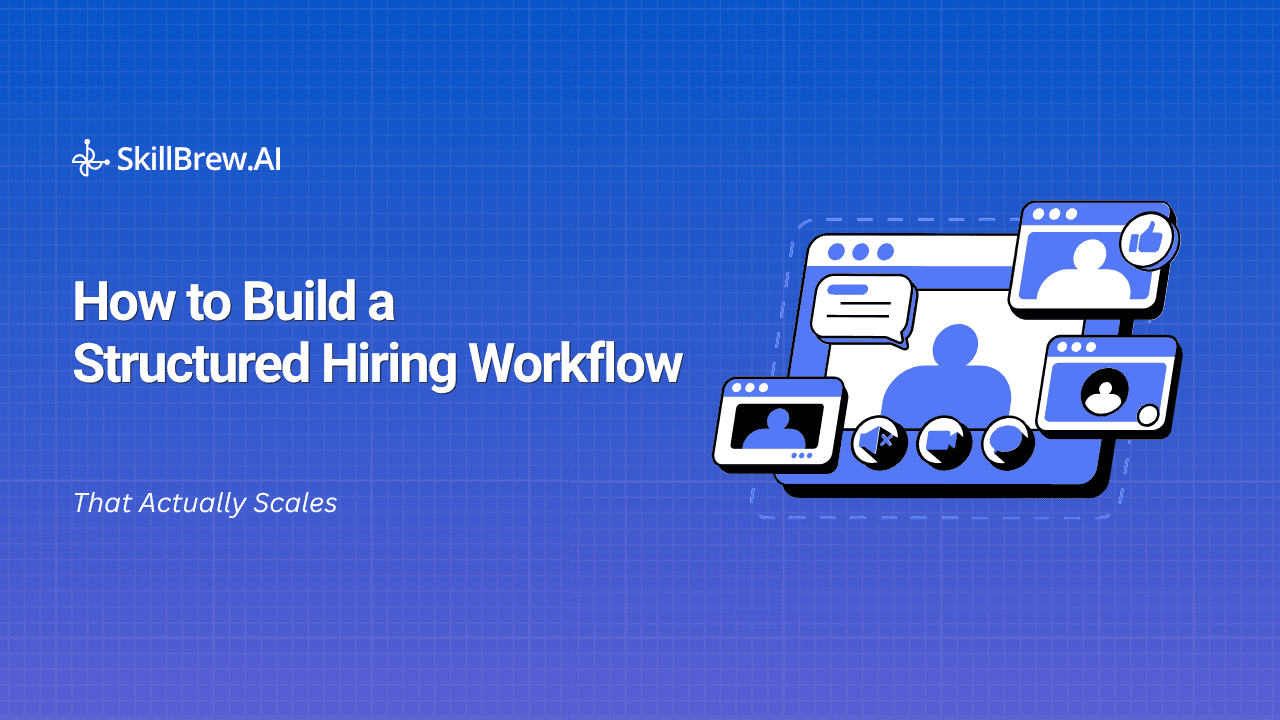
How to Build a Structured Hiring Workflow That Actually Scales
A recruiter hiring for a single software engineering role might receive 300–500 applications in less than a week. Within days, interview requests pile up, hiring managers delay feedback, and candidates lose interest. None of this happens because recruiters aren't working hard. It happens because the underlying process isn't designed to scale. As hiring volume grows, small cracks, unclear ownership, disconnected tools, slow feedback, turn into real bottlenecks that stretch out time-to-hire and d

A recruiter hiring for a single software engineering role might receive 300–500 applications in less than a week. Within days, interview requests pile up, hiring managers delay feedback, and candidates lose interest.
None of this happens because recruiters aren't working hard. It happens because the underlying process isn't designed to scale. As hiring volume grows, small cracks, unclear ownership, disconnected tools, slow feedback, turn into real bottlenecks that stretch out time-to-hire and drive candidates to faster-moving employers.
A scalable hiring workflow fixes this by creating a repeatable system: clear stages, clear owners, and clear service-level agreements (SLAs) from the moment a role is approved to the moment a candidate accepts an offer.
This guide walks through why hiring processes break down, how to build one that supports growth, and how modern teams are using automation and AI to remove friction along the way.
At a glance
| Hiring Challenge | Industry Finding |
| Candidate drop-off | Withdrawal risk rises sharply once feedback cycles stretch past a week |
| Recruiter workload | Recruiters report spending roughly 30-40%+ of their time on administrative coordination (SHRM) |
| Time-to-hire | Companies with optimized pipelines report 30-40% faster time-to-hire (LinkedIn Global Talent Trends) |
Table of Contents
- Why Most Hiring Processes Fail: Understand the root causes behind broken hiring processes, not just the symptoms.
- Benefits of a Structured Hiring Workflow: Why companies with defined processes often hire faster and more consistently than those relying on informal methods.
- Hiring Workflow vs Hiring Process: Clarify the difference between strategy and execution.
- Define Clear Hiring Stages: Learn how to structure a consistent end-to-end hiring process.
- Standardize Candidate Evaluations: Understand how to create fair and consistent assessment criteria.
- Automate Repetitive Hiring Tasks: Explore ways to reduce manual work through automation.
- Keep Recruiters and Hiring Managers Aligned: Improve collaboration between recruiters and hiring managers.
- Signs Your Process Needs Improvement: Identify early warning signals of a broken system.
- How Modern Teams Use AI in Hiring: See how AI is reshaping screening, interviews, and evaluations.
- Example of a Scalable Workflow: A structured, actionable system with ownership and SLAs.
- Common Bottlenecks: Identify where most hiring pipelines slow down.
- Common Mistakes to Avoid: Prevent issues that stop the process from scaling.
- Best Practices for Building a Scalable System: Proven principles to keep things efficient as you grow.
- Hiring Workflow Checklist: A quick framework to audit your current process.
- Implement Your Hiring Workflow with HireFlow: Learn how HireFlow helps streamline and automate hiring.
- Frequently Asked Questions: Quick answers to common questions.
- Final Thoughts: Key takeaways and next steps.
Why Most Hiring Processes Fail
Most companies don't intentionally design a broken hiring process, it evolves that way. What starts as one recruiter and one hiring manager gradually turns into a system with interview panels, technical assessments (AI Assessments), multi-step approvals, and half a dozen communication channels. Without structure, that system becomes fragile.
In practice, the failure points are usually structural rather than a matter of effort:
- Unclear ownership: no single person is accountable for moving a candidate forward at each stage.
- No standardized evaluation criteria: interviewers fall back on personal judgment instead of a shared scorecard.
- Disconnected tools: the ATS, spreadsheets, email, and chat all hold different versions of the truth.
- Delayed hiring manager feedback: reviews get deprioritized against other work, quietly stalling the pipeline.
- Manual interview coordination: recruiters lose hours per week just finding overlapping calendar slots.
- Email-based approvals: decisions get buried in inbox threads instead of tracked anywhere visible.
In many growing teams, interview scheduling, not sourcing, is the first part of the process to break under higher volume. Adding another recruiter rarely fixes this on its own, because the bottleneck usually isn't headcount; it's the number of manual hand-offs between people who each own one small piece of the pipeline. A delay in feedback slows scheduling, which delays offers, which increases drop-off, and the whole system shifts from structured to reactive.
Modern platforms like HireFlow address this by centralizing ownership and automating the hand-offs between stages.
Benefits of a Structured Hiring Workflow
- Faster time-to-hire: clear ownership and SLAs cut idle time between stages. LinkedIn's Global Talent Trends research associates optimized pipelines with 30-40% faster time-to-hire.
- Better candidate experience: candidates expect timely updates, and delays are one of the most common reasons they disengage.
- Lower recruiter workload: SHRM reports recruiters can lose 30-40%+ of their time to administrative coordination, much of which automation can absorb.
- More consistent decisions: the Society for Industrial and Organizational Psychology (SIOP) has found structured interviews produce more reliable outcomes than unstructured ones.
- Better cross-team collaboration: shared visibility reduces the back-and-forth between recruiters and hiring managers.
- Cleaner reporting: standardized stages make it possible to see exactly where a pipeline is slowing down.
A well-designed system doesn't just move faster, it produces better hires, because evaluation stops depending on which interviewer a candidate happened to get.
Candidate Experience in the Hiring Workflow
Candidate experience is often treated as a branding exercise, but it's really a process problem. Delayed responses, duplicated interview rounds, and inconsistent communication almost always trace back to a broken internal hand-off rather than a deliberate choice.
A structured hiring workflow fixes this by making communication predictable: automatic status updates at each stage, upfront timelines, and fewer unnecessary rounds between interviews. Recruiting industry research consistently names poor communication as one of the top reasons candidates drop out mid-process — which means pipeline efficiency is a direct driver of offer acceptance, not just a courtesy.
Placing this earlier in the process, right after ownership and stages are defined, keeps candidate experience from becoming an afterthought bolted onto the end of a hiring redesign.
Hiring Workflow vs Hiring Process
These terms are often used interchangeably, but they describe different layers of the same system.
| Hiring Process | Hiring Workflow |
| Overall recruitment strategy | Operational execution steps |
| High-level structure | Task-level actions |
| Defines what stages exist | Defines how candidates move between them |
Modern tools like HireFlow focus on the workflow layer, automating execution so the process actually runs the way it was designed to.
Define Clear Hiring Stages
Every scalable system starts with defined stages, ownership, and SLAs. Without that structure, candidates advance based on individual judgment instead of a shared standard, which produces inconsistent experiences and duplicated work.
A Typical Scalable Process
| Stage | Owner | Input | Output | SLA |
| Job Approval | Hiring Manager | Role requirement | Approved requisition | 1-2 days |
| Job Posting | Recruiter | Approved requisition | Live job posting | 1 day |
| Resume Screening | Recruiter | Applications | Shortlisted candidates | 48 hours |
| Initial Screening | Recruiter | Shortlisted pool | Interview-ready pool | 2-3 days |
| Skills Assessment | Candidate | Assessment link | Completed assessment | 3-5 days |
| Technical Interview | Interview Panel | Assessment results | Evaluation feedback | 24 hours |
| Final Interview | Hiring Manager | Interview feedback | Hiring decision input | 24-48 hrs |
| Offer Approval | Leadership | Selected candidate | Approved offer | 2 days |
| Offer & Onboarding | HR | Accepted offer | Onboarded employee | 3-5 days |
Every stage needs a defined owner, an expected turnaround time, and a measurable output. That's what prevents candidates from stalling silently between stages.
Standardize Every Candidate Evaluation
Without standardization, hiring becomes subjective and inconsistent — two interviewers can walk away from the same conversation with opposite conclusions. A structured process solves this with scorecards tied to each stage.
Resume Screening - learn how AI Resume Screening reduces manual resume review — should weigh relevant experience, technical skills match, domain exposure, and project quality.
Initial Screening should weigh communication skills, role understanding, motivation, and availability.
Technical Interview - see how AI Assessments standardize candidate evaluation, should weigh problem-solving ability, system design thinking, coding depth, and debugging approach.
Final Interview should weigh collaboration skills, leadership potential, cultural alignment, and long-term fit.
Automate Repetitive Hiring Tasks
At scale, the biggest inefficiency in hiring usually isn't evaluation quality, it's coordination. Recruiters switch between multiple tools just to schedule one interview loop, and that fragmentation compounds into delays across the whole pipeline.
Tasks worth automating first: interview scheduling, candidate notifications, reminder emails, assessment invitations, feedback collection, status updates, offer approvals, and job distribution. Discover how AI Interview Software automates first-round screening to see where this typically starts.
Workflow Automation vs Full Automation
A common misconception is that automation replaces recruiters. In reality, a strong recruiting system automates the repetitive administrative work, scheduling, reminders, status updates, while keeping final hiring decisions, cultural evaluation, and leadership assessment human-led. That balance is what a recruitment workflow built on a platform like HireFlow is designed to protect.
Where AI Fits in the Process
| Hiring Stage | Traditional Approach | AI-Assisted Approach |
| Resume review | Manual resume reading | Resume ranking & matching |
| Screening | Recruiter calls | AI screening interviews |
| Scheduling | Email coordination | Calendar automation |
| Interviews | Manual notes | AI-generated summaries |
| Reporting | Spreadsheet analysis | Automated hiring analytics |
AI isn't replacing recruiters here, it's absorbing the repetitive administrative work so recruiter time goes toward judgment calls instead of logistics.
Keep Recruiters and Hiring Managers Aligned
A recruiting system breaks down when teams operate in silos. Alignment requires shared visibility into candidate status, interview schedules, pending feedback, offer approvals, and hiring timelines, but visibility alone isn't enough. It also needs explicit SLAs: hiring managers commit to reviewing feedback within 24 hours, recruiters commit to scheduling within two business days. Recruiters frequently find that delays persist even after adding headcount if these feedback loops stay manual, the fix is the SLA, not the extra person.
Structured communication rhythms, weekly pipeline reviews, daily standups during active hiring sprints, and centralized feedback capture (instead of scattered email threads) are what make these SLAs stick. This is the kind of alignment a recruitment workflow inside a platform like HireFlow is built to support.
Real-World Examples Across Company Stages
Scaling SaaS: 50 to 250 employees
A mid-sized SaaS company scaling from 50 to 250 employees hit hiring bottlenecks as demand increased, recruiters were spending nearly 40-50% of their time just coordinating interviews, which slowed down evaluation. The result: inconsistent feedback, slow scheduling cycles, missed follow-ups, and declining offer acceptance. After introducing standardized scorecards, automated scheduling, stage-level SLAs, and a centralized dashboard, the company saw faster interview turnaround, more responsive hiring managers, and less coordination overhead within a few hiring cycles.
Startup: hiring 5 engineers
A seed-stage startup hiring its first five engineers doesn't need a nine-stage process, it needs speed and a founder who can move fast on final decisions. The workflow can collapse to four stages (screen, technical interview, founder conversation, offer), but the same principle applies: someone owns each stage, and there's an SLA even if it's informal.
Enterprise: managing 2,000 applications
A large enterprise running a single high-visibility req might see 2,000+ applications. Here the workflow's job is filtering at scale without losing quality, AI-assisted resume ranking and structured scorecards matter more than speed, since the bottleneck is volume, not urgency.
Campus hiring: 10,000 resumes
Campus recruiting compresses thousands of resumes into a narrow hiring window tied to the academic calendar. The workflow has to handle batch screening, group assessments, and cohort-based interview scheduling, a very different shape than the roughly linear pipeline used for a single senior hire.
The pattern across all four: the stages and SLAs change with company size and hiring volume, but the underlying discipline, defined ownership, defined hand-offs, doesn't.
Signs Your Process Needs Improvement
A pipeline rarely breaks all at once, it degrades gradually, and the signs are usually visible before time-to-hire numbers confirm it:
- Recruiters constantly chase interview feedback - if getting a hiring manager's input requires repeated follow-up, the SLA either doesn't exist or isn't enforced.
- Hiring managers forget scheduled interviews - a sign that scheduling and calendar sync aren't integrated into their normal workflow.
- Offer approvals take several days - usually a symptom of an approval chain routed through email instead of a tracked workflow, where a single unanswered message can stall everything behind it.
- Candidates drop out mid-process - often tied directly to the length of gaps between stages, not to compensation or role fit.
- Time-to-hire keeps increasing even as headcount grows, which points to a structural bottleneck rather than a capacity problem.
- Spreadsheets are used to track candidates - a strong signal that status information lives in someone's head rather than in a shared system.
If more than one or two of these show up consistently, it's a workflow problem, not an individual performance problem.
How Modern Teams Use AI in Hiring
Modern systems increasingly support resume ranking and candidate matching, AI-assisted screening interviews, automated scheduling and coordination, structured interview summaries, hiring pipeline analytics, and predictive hiring recommendations. Human judgment still owns the final call, especially for cultural fit and leadership evaluation, but AI is doing more of the work that used to eat recruiter hours.
Example of a Scalable Workflow
| Stage | Owner | SLA | Automation |
| Job Request | Hiring Manager | 1-2 days | Approval workflow |
| Job Posting | Recruiter | 1 day | Multi-channel posting |
| Resume Screening | Recruiter | 48 hours | AI-assisted filtering |
| Initial Screening | Recruiter | 2-3 days | Auto scheduling |
| Skills Assessment | Candidate | 3-5 days | Automated invites |
| Technical Interview | Panel | 24 hours | Calendar sync |
| Final Interview | Hiring Manager | 24-48 hrs | Feedback automation |
| Offer Stage | HR | 2 days | Approval workflow |
| Onboarding | HR Ops | 3-5 days | Document automation |
Common Bottlenecks in the Hiring Pipeline
Interview scheduling delays are usually the biggest one, coordinating five interviewer calendars for ten candidates can eat several recruiter-hours a week even when each individual email takes minutes.
Slow hiring manager feedback compounds everything downstream: scheduling, offers, and candidate communication all wait on it.
Candidate ghosting tends to follow long gaps between stages, candidates interviewing elsewhere simply accept a faster offer first.
Offer approval bottlenecks usually mean approvals are routed through email rather than a tracked chain with a visible owner at each step.
Inconsistent evaluations happen when scorecards aren't standardized, so two candidates get judged on different criteria depending on who interviewed them.
Lack of pipeline visibility makes all of the above harder to catch early, since nobody has a single view of where every candidate actually stands.
Common Mistakes to Avoid
Adding unnecessary interview rounds - each additional round adds days to the process without proportionally improving signal, and increases the odds a strong candidate accepts elsewhere first.
Using inconsistent scorecards - or none at all, turns evaluation into a matter of who interviewed the candidate rather than how they performed.
Relying on spreadsheets for tracking - spreadsheets don't enforce SLAs, don't notify anyone of a stalled candidate, and drift out of sync the moment two people edit at once.
Using disconnected tools - when the ATS, calendar, and communication tools don't talk to each other, someone has to manually keep them in sync, and that person becomes the bottleneck.
Leaving ownership unclear - if it's not obvious whose job it is to move a candidate forward, the default outcome is that nobody does.
Handling approvals via email - approvals get buried, forgotten, or lost in a long thread, with no easy way to see what's still pending.
Best Practices for Building a Scalable System
- Keep interview stages consistent across similar roles, so hiring managers and candidates know what to expect.
- Define clear ownership for every stage - one name, not a team, should be accountable.
- Set SLAs for feedback and approvals, and track adherence, not just intent.
- Use structured scorecards instead of subjective opinions, so evaluations are comparable across candidates and interviewers.
- Automate scheduling, reminders, and status updates so recruiter time goes to judgment calls, not logistics.
- Review hiring metrics monthly to catch drift before it shows up in time-to-hire.
Hiring Workflow Checklist
| Audit Question | Status |
| Does every hiring stage have an owner? | ☐ |
| Are interview scorecards standardized? | ☐ |
| Is scheduling automated? | ☐ |
| Are SLAs tracked? | ☐ |
| Is candidate status centralized? | ☐ |
Implement Your Hiring Workflow with HireFlow
If recruiters are spending hours chasing interview feedback, coordinating calendars, and updating spreadsheets, that's the exact friction HireFlow is built to remove. It centralizes approvals, scheduling, assessments, structured evaluations, and hiring analytics into one system, so recruiters always know who owns the next step, hiring managers get automated reminders instead of forgotten invites, and candidates move through the pipeline without unexplained gaps.
| Challenge | HireFlow Solution |
| Manual scheduling | Automated interview coordination |
| Inconsistent evaluations | Standardized scorecards |
| Poor visibility | Real-time hiring dashboard |
| Slow approvals | Workflow-based approvals |
| Spreadsheet tracking | Centralized pipeline |
| Feedback delays | Automated reminders |
HireFlow isn't meant to replace your existing hiring process, it's meant to strengthen the workflow that runs it, so teams spend less time coordinating and more time making informed hiring decisions.
Frequently Asked Questions
Q1. What is a hiring workflow?
A hiring workflow is the step-by-step operational process that moves candidates from application to onboarding.
Q2. How is a hiring workflow different from a hiring process?
The hiring process defines the stages; the hiring workflow defines how candidates actually move through those stages.
Q3. Why do hiring processes fail?
Mostly unclear ownership, inconsistent evaluations, manual coordination, and lack of automation, not lack of effort.
Q4. How does AI improve hiring pipelines?
By automating screening, scheduling, and evaluation summaries, which frees recruiter time for judgment calls.
Q5. How many stages should a hiring process have?
Most organizations use six to nine stages, depending on role complexity and company size.
Q6. What metrics should recruiters track?
Time-to-hire, screening time, drop-off rate, offer acceptance rate, and feedback turnaround time.
Q7. Who owns a hiring workflow?
Typically Talent Acquisition or Recruiting Operations owns the design, while execution is shared across recruiters, hiring managers, and interviewers.
Q8. What software helps manage a hiring workflow?
Applicant Tracking Systems (ATS) and recruitment platforms like HireFlow help manage the process through automation.
Final Thoughts
A scalable hiring workflow isn't about adding more recruiters or more interview rounds, it's about removing the friction between stages: unclear ownership, untracked approvals, and manual coordination that quietly stalls good candidates. The companies that hire fastest aren't necessarily the ones with the most headcount; they're the ones where every stage has a named owner, a tracked SLA, and a standardized way to evaluate candidates.
Start small if you need to, define ownership and SLAs for your current stages before you automate anything. Once that foundation is in place, tools like HireFlow can take over the repetitive coordination work, so your team's time goes toward the decisions that actually require human judgment: who to hire, and why.
See AI-powered hiring in action
Discover how SkillBrew helps hiring teams cut time-to-hire by 60% with skill-validated assessments and AI-ranked shortlists.
Book a free demoNo commitment required · 30 minutes
Continue reading
View All Posts