Campus Placement Drive
7 Ways to Improve Your Campus Recruitment Strategy
Campus hiring helps organizations connect with fresh talent, develop future leaders, and build a sustainable talent pipeline. However, recruiting graduates requires more than visiting colleges, conducting placement drives, and extending job offers. Recruiters must identify suitable institutions, evaluate job-ready skills, manage large application volumes, and keep candidates engaged throughout the process. Without a structured approach, these activities can become time-consuming and lead to inc

Campus hiring helps organizations connect with fresh talent, develop future leaders, and build a sustainable talent pipeline. However, recruiting graduates requires more than visiting colleges, conducting placement drives, and extending job offers.
Recruiters must identify suitable institutions, evaluate job-ready skills, manage large application volumes, and keep candidates engaged throughout the process. Without a structured approach, these activities can become time-consuming and lead to inconsistent hiring decisions.
A well-planned Campus recruitment strategy helps organizations align hiring requirements with candidate capabilities, improve recruitment efficiency, and create a better experience for students.
In this blog, we explore seven practical ways to improve campus hiring, evaluate candidates more consistently, and build stronger relationships with educational institutions.
Key Takeaways
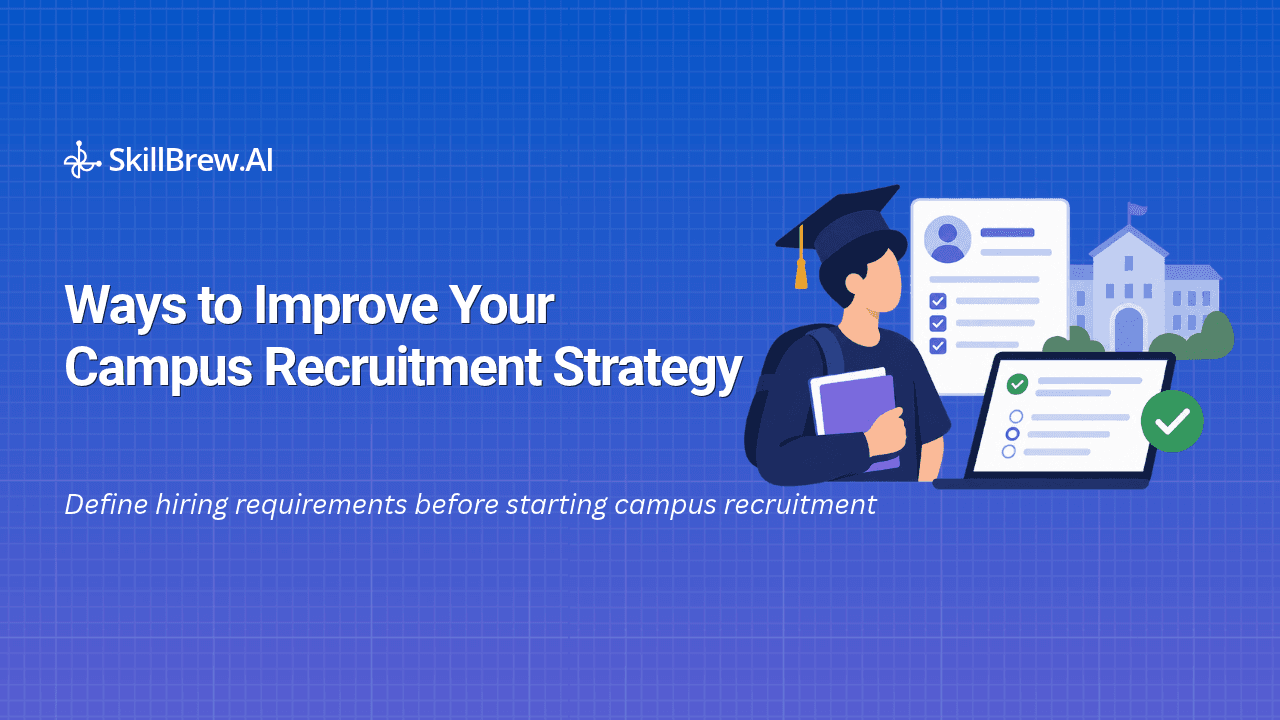
- Define hiring requirements before starting campus recruitment.
- Partner with colleges that align with your talent needs.
- Use role-specific assessments to evaluate practical skills.
- Automate repetitive recruitment tasks.
- Improve communication throughout the candidate journey.
- Standardize interviews and evaluation criteria.
- Track recruitment metrics to identify areas for improvement.
What Is a Campus Recruitment Strategy?
A Campus recruitment strategy is a structured approach to attracting, assessing, and hiring students and recent graduates from colleges and universities. It outlines how organizations identify target institutions, evaluate candidates against role-specific requirements, and build a pipeline of early-career talent.
The process typically includes workforce planning, campus selection, candidate screening, assessments, interviews, offer management, and onboarding.
For example, a technology company hiring graduate engineers might partner with engineering colleges, conduct coding assessments, and evaluate problem-solving skills before scheduling interviews. A customer support organization might prioritize communication skills and situational judgment.
The approach should reflect the competencies required for each position rather than applying identical selection criteria to every role.
7 Ways to Improve Your Campus Recruitment Strategy
1. Define Clear Hiring Goals and Requirements
Before contacting colleges, establish what your organization needs from incoming graduates. Unclear hiring requirements can lead to irrelevant applications, inconsistent screening, and mismatches between selected candidates and job responsibilities.
Start by identifying:
- The number of graduates required for each department.
- The responsibilities and expectations associated with each role.
- Essential technical and behavioral competencies.
- Relevant eligibility criteria.
- Hiring timelines, compensation ranges, and onboarding schedules.
A clear Campus recruitment strategy gives recruiters measurable objectives and helps them prioritize suitable candidates.
For example, a company planning to hire 40 software engineering graduates should define the required programming fundamentals, analytical skills, and problem-solving abilities before designing its selection process.
Pro tip: Consult hiring managers before launching the campaign. Their input helps recruiters evaluate candidates against actual business requirements.
2. Build Relationships With the Right Colleges
The educational institutions you target can influence the quality and consistency of your hiring pipeline. Rather than visiting as many colleges as possible, prioritize institutions whose academic programs and student capabilities align with your open positions.
Consider these approaches:
- Review academic programs and previous placement outcomes.
- Connect with placement officers and faculty members.
- Participate in workshops, career fairs, and industry talks.
- Maintain communication outside the placement season.
- Evaluate the performance of previous campus hires.
Long-term relationships help employers understand student capabilities while introducing candidates to workplace expectations.
For instance, an organization can conduct a workshop on technical interviews or professional communication before recruitment season. Students gain practical guidance, while recruiters build awareness of the company and its opportunities.
A sustainable Campus recruitment strategy treats institutional partnerships as ongoing relationships rather than one-time placement arrangements.
Pro tip: Review historical hiring outcomes alongside current requirements when selecting campuses for future recruitment drives.
3. Evaluate Candidates Through Skill-Based Assessments
Academic scores and resumes provide useful information, but they do not always demonstrate whether candidates can perform job-related tasks. Skill-based assessments help recruiters evaluate practical abilities, reasoning, communication, and potential.
Depending on the role, these assessments may include:
- Technical assessments: Coding, debugging, and technical knowledge.
- Aptitude assessments: Logical reasoning, numerical ability, and data interpretation.
- Communication assessments: Spoken communication and comprehension.
- Situational assessments: Responses to realistic workplace scenarios.
- Role-specific tasks: Exercises reflecting actual job responsibilities.
For example, a customer support candidate might respond to a simulated customer complaint, while a software engineering candidate completes a programming exercise. Both are evaluated against competencies relevant to their respective roles.
A consistent Campus recruitment strategy uses predefined scoring criteria and considers assessment results alongside interviews and other relevant evidence.
SkillBrew.AI's AI Assessment Builder can help recruiters create role-specific assessments from a job description or prompt. The platform supports coding, situational, behavioral, and other assessment formats, helping hiring teams prepare relevant evaluations for different roles.
Pro tip: Keep assessments relevant to the position and provide clear instructions. The objective is to evaluate job readiness, not introduce unnecessary barriers.
4. Automate Repetitive Recruitment Tasks
Campus drives can generate hundreds or thousands of applications within a short period. Managing every application, reminder, interview schedule, and feedback record manually can overwhelm recruitment teams.
Automation can help streamline repetitive activities, including:
- Organizing applications and candidate records.
- Applying predefined eligibility criteria.
- Sending assessment invitations and reminders.
- Coordinating interview schedules.
- Collecting interviewer feedback.
- Tracking candidate progress and recruitment outcomes.
Recruitment automation gives hiring teams more time to evaluate candidates and build relationships with educational institutions.
For example, recruiters can use a centralized workflow to organize assessment results and identify candidates who meet predefined requirements. This reduces manual consolidation across spreadsheets and makes candidate progress easier to review.
Organizations exploring these workflows can also read SkillBrew.AI's guide to automating the campus hiring process.
Automation should support—not replace—appropriate human oversight. Review screening rules regularly, protect candidate information, and ensure that important decisions are based on relevant evidence.
Pro tip: Start with the most time-consuming administrative tasks, then measure whether automation improves processing time and reduces manual effort.
5. Improve the Candidate Experience
Campus recruitment is often a student's first meaningful interaction with a potential employer. Unclear instructions, delayed updates, and complicated application processes can discourage qualified candidates from continuing.
Improve the experience by:
- Publishing clear job descriptions and eligibility requirements.
- Explaining each selection stage in advance.
- Providing assessment instructions and realistic deadlines.
- Sharing timely application and interview updates.
- Offering convenient interview scheduling.
- Providing a channel for candidate questions.
A positive experience helps candidates understand what to expect and gives them a more professional impression of the organization.
Consider a placement drive where candidates complete an assessment but receive no information about the next stage. Recruiters can reduce uncertainty by communicating expected timelines and notifying candidates when their application status changes.
Pro tip: Review the candidate journey from application to offer acceptance. Identify stages where candidates experience confusion, unnecessary effort, or long delays.
6. Standardize Interviews and Evaluation Criteria
Interviews help recruiters assess communication, motivation, problem-solving, and role suitability. However, inconsistent questions and subjective scoring can make comparisons between candidates difficult.
A structured interview process improves consistency by establishing common evaluation standards.
To implement one:
- Define the competencies required for each role.
- Prepare consistent core interview questions.
- Create scoring rubrics for evaluating responses.
- Train interviewers to apply the criteria consistently.
- Record feedback promptly.
- Review interview results alongside assessment scores.
For graduate management trainees, interviewers might assess analytical thinking, teamwork, and decision-making. For junior developers, they may focus on programming fundamentals and technical reasoning.
Candidates applying for the same role should be evaluated against comparable criteria, even when they attend interviews with different recruiters.
A standardized Campus recruitment strategy makes hiring decisions easier to compare and explain while reducing reliance on individual impressions.
Pro tip: Combine structured interview feedback with assessment results and other job-related evidence rather than relying on a single interviewer's opinion.
7. Track Recruitment Metrics and Improve Continuously
Campus hiring should evolve with every recruitment cycle. Tracking relevant metrics helps organizations identify bottlenecks, evaluate recruitment activities, and understand whether selection methods produce successful hires.
| Recruitment metric | What it measures |
| Time to hire | Time from a candidate entering the hiring process to accepting an offer, using consistently defined start and end points. |
| Cost per hire | Recruitment expenditure divided by the number of hires. |
| Assessment completion rate | Percentage of invited candidates who complete the assessment. |
| Interview-to-offer ratio | Number of interviews conducted relative to offers extended. |
| Offer acceptance rate | Percentage of offers accepted by candidates. |
| Joining rate | Percentage of selected or offer-accepting candidates who actually join, using a clearly defined denominator. |
| Quality of hire | How effectively new employees meet relevant performance and retention expectations. |
For example, suppose recruiters notice a low assessment completion rate. Rather than immediately changing the passing score, they should investigate invitation delivery, assessment duration, instructions, technical accessibility, and candidate feedback.
If invitations are reaching candidates successfully but completion remains low, feedback may reveal that the assessment is too long or its instructions are unclear. Recruiters can then test targeted changes and compare completion rates in a subsequent drive.
This data-driven approach makes a Campus recruitment strategy easier to evaluate and improve over time.
For more guidance, read SkillBrew.AI's article on campus hiring metrics.
Pro tip: Review recruitment performance after each placement season and document which changes should be tested during the next cycle.
Campus Recruitment Checklist
Before launching your next hiring campaign, confirm that the following steps are covered.
- Define hiring targets and role requirements.
- Identify suitable colleges and placement partners.
- Prepare role-specific assessments and interview questions.
- Establish consistent evaluation criteria.
- Organize recruitment workflows and candidate communications.
- Coordinate interviewers and hiring managers.
- Track recruitment metrics and candidate progress.
- Review outcomes and document improvements.
FAQs
1. How can organizations improve campus recruitment?
Start with clear hiring requirements, suitable college partnerships, and role-specific assessments. Standardized interviews, timely communication, recruitment automation, and regular performance reviews can further improve the process.
2. Why is a campus recruitment strategy important?
It helps organizations identify suitable graduates, manage large application volumes, evaluate candidates consistently, and develop relationships with educational institutions. It also supports more informed hiring decisions.
3. How can technology improve campus hiring?
Recruitment technology can organize applications, support online assessments, coordinate interviews, and track candidate progress. AI-powered assessment tools can also help create role-specific evaluations while recruiters retain oversight of hiring decisions.
4. Which assessments are useful for campus recruitment?
The right assessment depends on the position. Coding tests suit technical roles, aptitude tests measure reasoning, and communication or situational assessments can support evaluation for customer-facing positions.
5. How should recruiters measure campus hiring success?
Useful metrics include time to hire, cost per hire, assessment completion, offer acceptance, joining rates, and quality of hire. Reviewing these measures together provides a broader understanding of recruitment performance.
Conclusion
Effective campus hiring requires clear planning, relevant assessments, consistent interviews, and strong candidate engagement. Organizations that improve these areas can make recruitment more organized while building a dependable pipeline of early-career talent.
A successful Campus recruitment strategy also depends on continuous measurement. Reviewing candidate feedback, recruitment metrics, and new-hire outcomes helps teams identify weaknesses and make informed improvements during future placement cycles.
SkillBrew.AI helps hiring teams create role-specific assessments using AI-powered assessment solutions. Explore the AI Assessment Builder to see how structured, skill-focused evaluations can support your campus hiring workflow.
See AI-powered hiring in action
Discover how SkillBrew helps hiring teams cut time-to-hire by 60% with skill-validated assessments and AI-ranked shortlists.
Book a free demoNo commitment required · 30 minutes
Continue reading
View All Posts