AI Interview
Mock Interview preparation: A Step-by-Step Guide for Job Candidates
Preparing for a job interview can feel challenging, especially when you are unsure what questions to expect or how to explain your skills effectively. Whether you are a fresher preparing for campus placements or an experienced professional looking for a new opportunity, practicing before the actual interview can help you perform with greater confidence. A mock interview recreates a real interview environment, allowing you to practice answering questions, explaining your experience, and handling

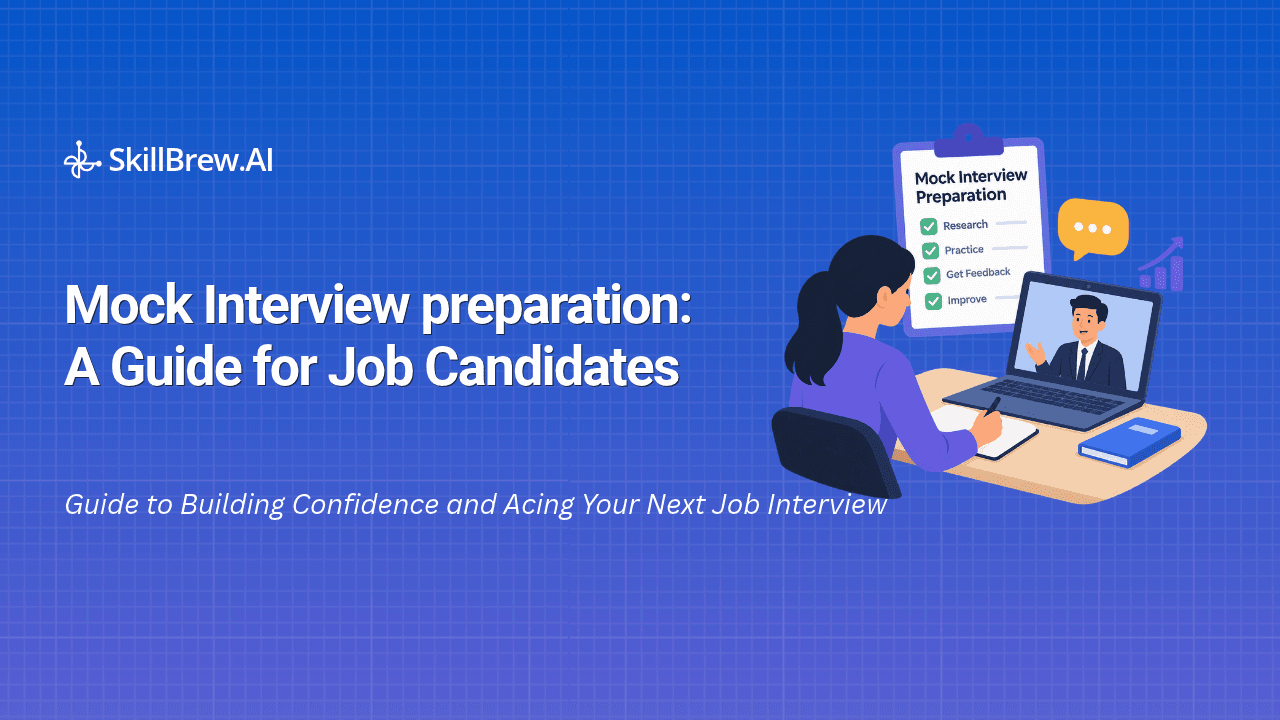
Preparing for a job interview can feel challenging, especially when you are unsure what questions to expect or how to explain your skills effectively. Whether you are a fresher preparing for campus placements or an experienced professional looking for a new opportunity, practicing before the actual interview can help you perform with greater confidence.
A mock interview recreates a real interview environment, allowing you to practice answering questions, explaining your experience, and handling follow-up questions before meeting a recruiter.
Effective Mock Interview preparation involves more than memorizing answers. It requires understanding the job description, practicing relevant questions, reviewing your performance, and improving the areas where you struggle.
This guide explains how mock interviews work, how to prepare for them step by step, and how to use practice sessions to improve your performance in real interviews.
Key Takeaways
- Mock interviews help candidates identify weaknesses before attending actual job interviews.
- Reviewing the job description and researching the company makes preparation more relevant.
- Practicing behavioral, technical, and role-specific questions improves answer quality.
- Recording responses and collecting feedback helps identify areas for improvement.
- A structured preparation schedule makes practice more effective.
- AI-powered interview tools can provide additional opportunities to practice independently.
What Is a Mock Interview?
A mock interview is a practice session that simulates a real job interview. It may involve a friend, mentor, career coach, or AI-powered interview platform asking questions relevant to the position you want.
These sessions can include introductory questions, behavioral scenarios, technical discussions, and questions about your education or professional experience.
For example, a software developer may practice explaining programming concepts and debugging code, while a marketing candidate may discuss campaign performance and audience research.
The goal is to become familiar with the interview format, communicate your abilities clearly, and identify areas that require further preparation. Mock Interview preparation works best when your practice reflects the requirements of the position rather than focusing exclusively on generic questions.
Why Is Mock Interview Preparation Important?
Build Confidence
Repeated practice makes it easier to discuss your skills, achievements, and career goals. You can become more comfortable answering questions without relying on memorized responses.
Improve Communication
Practice helps you organize your thoughts, reduce unnecessary filler words, and explain complex ideas clearly. These skills are valuable even when you already have strong technical knowledge.
Identify Knowledge Gaps
A practice session may reveal that you struggle to explain a technical concept or provide evidence for a skill listed on your resume. Recognizing these gaps gives you time to revise before the actual interview.
Understand Interview Expectations
Different roles require different preparation strategies. A technical interview may involve coding problems, while a customer support interview may focus on communication and situational judgment.
A structured approach to Mock Interview preparation helps you understand these expectations and focus your efforts where they matter most.
How to Prepare for a Mock Interview: A Step-by-Step Guide
Step 1: Understand the Job Description
Begin by reviewing the job description carefully. Identify the required qualifications, responsibilities, technical skills, and communication expectations.
For example, a data analyst position may require SQL, spreadsheet proficiency, data visualization, and analytical thinking. Your practice session should include questions that evaluate these skills.
What to do:
- Highlight the essential skills and qualifications.
- Identify responsibilities that may lead to interview questions.
- Match your experience, academic projects, or internships to the requirements.
- List topics you need to revise.
This helps you prioritize relevant preparation instead of spending time on unrelated questions.
Step 2: Research the Company
Learn about the company's products, services, customers, industry, and work culture. Understanding the organization helps you explain why you are interested in the role.
Prepare answers to questions such as:
- What do you know about our company?
- Why do you want to work here?
- Why are you interested in this position?
- How do your skills align with our requirements?
During Mock Interview preparation, connect your answers to specific aspects of the company and position rather than relying on generic statements.
Step 3: Prepare for Common Interview Questions
Start with questions that frequently appear in interviews:
- Tell me about yourself.
- What are your strengths and weaknesses?
- Why should we hire you?
- Describe a challenge you have faced.
- Where do you see yourself in the next few years?
Prepare key talking points rather than memorizing complete answers. For your introduction, briefly explain your background, relevant skills or achievements, and interest in the position.
Freshers can discuss academic projects, internships, and relevant coursework. Experienced professionals can highlight responsibilities, accomplishments, and career progression.
Step 4: Use the STAR Method for Behavioral Questions
Behavioral questions ask you to describe how you handled a situation in the past. The STAR method helps you structure your response.
- Situation: Describe the context.
- Task: Explain your responsibility.
- Action: Describe the steps you took.
- Result: Explain the outcome.
Example question: Tell me about a time you handled a challenging deadline.
Sample answer:
- Situation: During a college project, our team had to complete a presentation and working prototype within one week.
- Task: I was responsible for coordinating the research and ensuring my part was completed on time.
- Action: I divided my work into smaller tasks, prioritized the essential features, and communicated progress to my teammates.
- Result: We completed the project before the deadline and delivered the presentation as planned.
This example demonstrates how a candidate can explain a specific experience instead of simply claiming to be organized or hardworking.
For stronger answers, include measurable results when you have reliable figures. Practicing this structure during Mock Interview preparation can make your responses more focused and convincing.
Step 5: Practice Role-Specific Questions
General questions are important, but you should also prepare for tasks related to your profession.
| Job Role | Questions or Tasks to Practice |
| Software Developer | Programming concepts, debugging, coding problems |
| Data Analyst | SQL, spreadsheets, data interpretation |
| QA Engineer | Test cases, bug reporting, testing methodologies |
| Customer Support Executive | Customer complaints, communication scenarios |
| Sales Executive | Sales pitches, objection handling |
| Content Writer | Writing samples, editing, research |
Review fundamental concepts and prepare examples of how you have applied your skills. If the role involves a practical assessment, simulate the task under similar time constraints.
Step 6: Choose the Right Practice Format
You can conduct a mock interview in several ways.
Practice with a friend or mentor: Ask someone to interview you using prepared questions and provide honest feedback.
Work with a career coach: Get guidance on your responses, communication, and interview strategy.
Use an AI interview platform: Practice independently with role-specific questions and, depending on the platform, receive structured feedback.
Record yourself: Answer questions aloud, review the recording, and identify problems with clarity, pacing, or answer structure.
Choose a method that fits your goals and available time. Combining independent practice with feedback from another person can give you a broader view of your performance. A combination of these approaches can make Mock Interview preparation more flexible and effective.
Step 7: Simulate the Real Interview Environment
Treat your practice session as seriously as the actual interview.
Choose a quiet location, dress appropriately, and follow the expected interview format. For online interviews, check your camera, microphone, lighting, internet connection, and background.
During the session:
- Listen carefully before answering.
- Pause briefly to organize your thoughts.
- Maintain a natural speaking pace.
- Support your claims with relevant examples.
- Ask for clarification when necessary.
- Avoid interrupting or rushing through responses.
Realistic practice helps you become familiar with the practical demands of an interview, not just the questions.
Step 8: Review Your Performance and Collect Feedback
After the session, review your answers or recording. Evaluate whether your responses were relevant, organized, clear, and appropriately detailed.
Ask your practice interviewer:
- Which answer was least convincing?
- Did I explain my experience clearly?
- Were my examples specific enough?
- Which topics should I revise?
- What should I improve in the next session?
Choose two or three improvement areas and create an action plan. For example, if your answers lack detail, prepare specific examples from your academic or professional experience.
Effective Mock Interview preparation depends on applying feedback rather than simply repeating the same questions.
A Three-Day Mock Interview Preparation Plan
If your interview is approaching, use this short schedule to organize your time.
| Day | Focus | Tasks |
| Day 1 | Research and planning | Review the job description, research the company, prepare your introduction, and list likely questions. |
| Day 2 | Practice and revision | Practice behavioral and role-specific questions, revise important concepts, and record your answers. |
| Day 3 | Simulation and review | Complete a full practice interview, review feedback, address remaining gaps, and check your interview setup. |
Adjust the schedule to your experience and the complexity of the role. If you have only a few hours, prioritize the job requirements, common questions, and your weakest areas.
Common Mock Interview Mistakes to Avoid
Memorizing Answers Word for Word
Memorized answers can sound unnatural and become difficult to adapt to follow-up questions. Practice key talking points and explain them in your own words.
Ignoring the Job Description
Generic preparation may leave you unprepared for role-specific questions. Focus on the actual requirements of the position.
Practicing Without Feedback
Repeating the same answers without reviewing them can reinforce existing weaknesses. Use recordings, peer feedback, or structured evaluation to identify problems.
Focusing Only on Technical Knowledge
Technical expertise matters, but many roles also require communication, problem-solving, and teamwork. Balance technical revision with behavioral practice.
Becoming Discouraged by Mistakes
The purpose of a mock interview is to identify areas for improvement in a practice environment. Review what went wrong, make adjustments, and try again.
How AI Can Support Mock Interview Preparation
AI-powered interview tools provide another way to practice without coordinating every session with a friend or mentor.
Depending on the platform, they can offer role-based questions, simulated interview conversations, performance feedback, and opportunities to repeat practice sessions.
SkillBrew.AI offers an AI mock interview practice experience where candidates can choose roles and skills, answer interview questions, and review performance insights. This can help candidates practice at their convenience and identify areas that need additional attention.
AI feedback should be treated as guidance rather than a guarantee of interview success. Automated evaluations may not capture every aspect of context or professional judgment, so combine them with your own review and human feedback whenever possible.
Mock Interview preparation Checklist
Before your next session, check that you have completed these tasks:
- Reviewed the job description.
- Researched the company.
- Prepared an introduction.
- Practiced common interview questions.
- Prepared STAR-based behavioral examples.
- Revised role-specific concepts.
- Checked your interview environment and equipment.
- Reviewed your performance and identified improvement areas.
Frequently Asked Questions
1. What is Mock Interview preparation?
It involves practicing for a real job interview through simulated sessions. This includes researching the role, preparing answers, practicing questions, collecting feedback, and improving communication.
2. How many mock interviews should I practice before a real interview?
There is no fixed number. Two or three focused sessions may be enough for some candidates, while others may need additional practice. Focus on improving your answers rather than reaching a particular number.
3. Can freshers benefit from mock interviews?
Yes. Freshers can practice introductions, explain academic projects, discuss their skills, and prepare for campus placements or entry-level recruitment.
4. Can I prepare for a mock interview on my own?
Yes. You can record your answers, review your responses, and use an AI interview platform. Feedback from a mentor or peer can provide additional perspective.
5. Are AI mock interviews useful for job candidates?
AI mock interviews can offer convenient practice, role-specific questions, and structured feedback, depending on the platform. They work best as a supplement to focused learning and realistic interview practice.
Conclusion
Successful interviews require more than memorizing answers. Candidates need to understand the role, explain their skills with relevant examples, and respond thoughtfully under pressure.
A structured Mock Interview preparation routine can help you develop these abilities. Start by reviewing the job description, practicing common and role-specific questions, and simulating the actual interview environment. Then review your performance, apply feedback, and practice again.
If you want to practice independently, try SkillBrew.AI's mock interview platform to explore role-based interview practice and performance insights.
Consistent practice, targeted revision, and constructive feedback can help you approach your next interview with greater confidence and a clearer understanding of your strengths.
See AI-powered hiring in action
Discover how SkillBrew helps hiring teams cut time-to-hire by 60% with skill-validated assessments and AI-ranked shortlists.
Book a free demoNo commitment required · 30 minutes
Continue reading
View All Posts